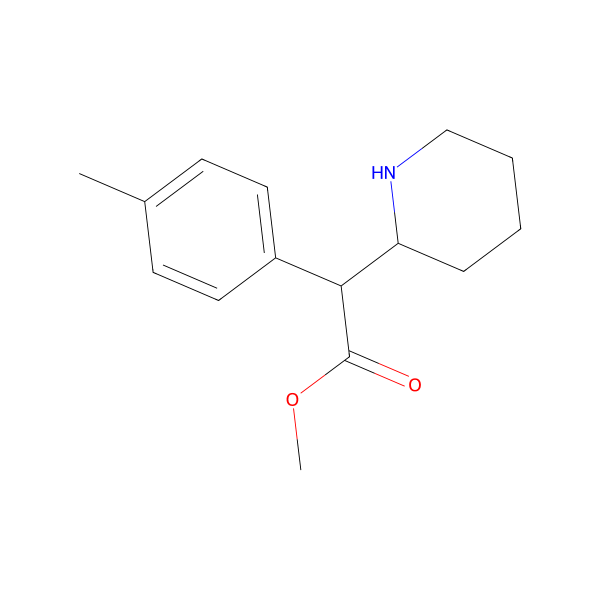
4-Methylmethylphenidate (4-Me-TMP), also known as 4-MMPH, is a synthetic stimulant related to methylphenidate. It belongs to the phenidate family, not the cathinones: its structure contains a piperidine ring and an ester group but no β-keto group. It has appeared in new psychoactive substance monitoring and has been detected in a small number of toxicology samples, although clinical information remains scarce.
Chemistry
4-Me-TMP is a ring-substituted methylphenidate analogue. A methyl group is attached to the para position of the phenyl ring, while the rest of the molecule retains the methylphenidate framework. The compound is stereochemically complex and is commonly described in relation to its threo form.
The abbreviation can be confusing because “TMP” is also used for unrelated compounds. In this context, 4-Me-TMP refers to 4-methylmethylphenidate, not a cathinone or a methamphetamine derivative.
Pharmacology
Methylphenidate and its analogues act mainly by inhibiting the dopamine transporter (DAT), reducing the reuptake of dopamine into nerve terminals. The available literature suggests that 4-methylmethylphenidate is somewhat less potent than methylphenidate, but its pharmacology has not been studied extensively.
A study of methylphenidate analogues found that related ring- and nitrogen-substituted compounds inhibited dopamine transport without producing rapid dopamine release in the experimental system. These results provide context for the phenidate family, but should not be mistaken for a complete study of 4-Me-TMP itself (Wayment and colleagues, 1999).
Reported effects
There is little reliable information about the subjective effects of 4-Me-TMP. A small number of online accounts compare it with methylphenidate or ethylphenidate, describing functional stimulation and increased alertness. These reports are anecdotal and do not establish how the compound affects people generally.
Based on its structural relationship to methylphenidate, possible effects include increased wakefulness and concentration. Anxiety, irritability, elevated heart rate and blood pressure, and impaired sleep are class-related concerns, but their frequency has not been established for 4-Me-TMP.
Forensic findings and safety
The Center for Forensic Science Research and Education reported the first identification of 4-methylmethylphenidate in a US toxicology case in 2022. The compound was detected in blood, urine and vitreous fluid from a case submitted by a coroner’s office in Ohio. The laboratory had not identified it in drug materials at the time of its 2023 monograph (CFSRE, 2023).
The monograph notes that expected adverse effects may resemble those of other phenidates, including tachycardia, hypertension, irritability, paranoia and anxiety. This is an inference from structural similarity rather than a list established in controlled human studies.
Research limitations
No clinical trial has established the acute toxicity, metabolism, dependence potential or long-term effects of 4-Me-TMP. Detection in a single forensic case confirms exposure, without showing how widespread its use is or reliably establishing the clinical risk.
Related compounds
4-Me-TMP is related to Methylphenidate, Ethylphenidate and other phenidate analogues. It should not be grouped chemically with synthetic cathinones, even though both groups include stimulant substances.
Reviews
There are no reviews yet.