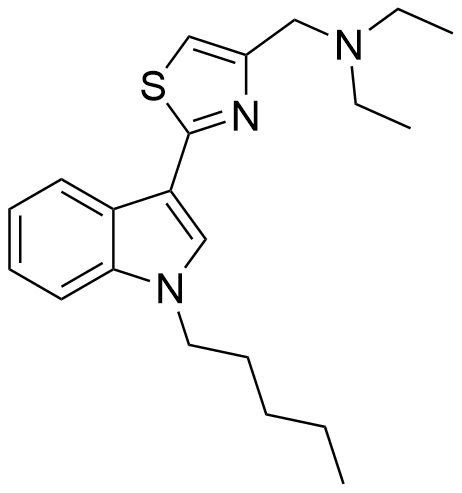
PTI-1, also known as SGT-48, belongs to the category of indole-based synthetic cannabinoids, notable for its unique inclusion of a thiazole group. This compound is closely associated with PTI-2 and shares a common origin in the lineage of indole-3-heterocycle compounds initially pioneered by Organon and later explored by Merck.
PTI-1 (SGT-48) is an indole-based synthetic cannabinoid. It is part of a group of synthetic cannabinoids that contain a thiazole group.
How does PTI-1 differ from PTI-2?
PTI-1 is closely related to PTI-2, and both are synthetic cannabinoids. They are often considered simplified analogues of indole-3-heterocycle compounds developed initially by Organon and researched by Merck. The critical difference lies in their specific chemical structures.
What is the origin of PTI-1 and PTI-2?
These compounds can be traced back to the research efforts of Organon and Merck, which have explored various synthetic cannabinoids over the years.
Is PTI-1 legal?
The legal status of PTI-1 can vary by location and change over time. It’s essential to stay updated with local and national regulations regarding synthetic cannabinoids.
Are there any known medical or recreational uses for PTI-1?
Synthetic cannabinoids like PTI-1 are often associated with recreational use, and their effects can be unpredictable and potentially harmful. There are no approved medical uses for PTI-1.
What are the potential risks associated with PTI-1 use?
The use of synthetic cannabinoids, including PTI-1, can be dangerous and is linked to adverse health effects. These can include anxiety, hallucinations, increased heart rate, and more severe complications in some cases.
Is PTI-1 detected in standard drug tests?
While standard drug tests may not specifically target PTI-1, they can sometimes detect synthetic cannabinoids as a broad category. However, the detection largely depends on the specific compounds included in the test.
Where can I find more information about PTI-1 and its effects?
It’s advisable to consult reputable sources, such as scientific publications and government health agencies, to learn more about PTI-1 and the potential health risks associated with its use.
References
PTI-1. Cayman Chemical. Retrieved 8 July 2015.
US 7700634, Adam-Worrall J, Morrison AJ, Wishart G, Kiyoi T, McArthur DR, “(Indol-3-yl) heterocycle derivatives as agonists of the cannabinoid CB1 receptor.”, issued 20 April 2010, assigned to Organon NV
US 7763732, Paul David Ratcliffe PD, Adam-Worrall J, Morrison AJ, Francis SJ, Kiyoi T, “Indole Derivatives”, issued 27 July 2010, assigned to Organon NV
Kiyoi T, Adam JM, Clark JK, Davies K, Easson AM, Edwards D, et al. (March 2011). “Discovery of potent and orally bioavailable heterocycle-based cannabinoid CB1 receptor agonists”. Bioorganic & Medicinal Chemistry Letters. 21 (6): 1748–53. doi:10.1016/j.bmcl.2011.01.082. PMID 21316962.