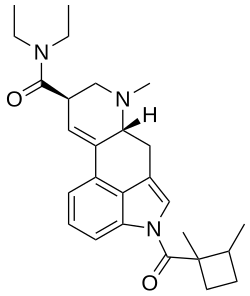
1D-LSD is the name used for 1-(1,2-dimethylcyclobutane-1-carbonyl)-LSD, an N1-acyl lysergamide. The compound became visible in online product listings in the early 2020s, but forensic investigations found that some blotters labelled 1D-LSD actually contained 1T-LSD. In August 2026, researchers published the first detailed synthesis and analytical characterisation of the proposed 1D-LSD structure, including its stereoisomeric forms.
Chemistry and stereochemistry
The proposed structure retains the LSD ergoline core and N,N-diethylamide group, with a 1,2-dimethylcyclobutane-1-carbonyl substituent at the indole nitrogen. The cyclobutane carboxylic-acid component can occur as four stereoisomers. As a result, the 1D-LSD material examined in the 2026 study was a mixture of four diastereomers rather than a single stereochemically uniform compound.
The researchers separated the mixture into two groups and used NMR spectroscopy, supported by quantum-chemical calculations, to assign the fractions. LC-MS, GC-MS and FT-IR were then used to characterise the compound and distinguish it from 1T-LSD (Okada and colleagues, 2026).
Why the name has caused confusion
Several products sold as 1D-LSD were found to contain 1-(thiophene-2-carbonyl)-LSD, or 1T-LSD. The two compounds have the same nominal mass but different structures and different analytical properties. The 2026 study compared them directly and showed that they can be distinguished when suitable analytical methods are used.
The proposed 1D-LSD structure also appears in the 2024 patent publication Prodrugs of substituted ergolines, where it is listed as SYN-L-229. Its inclusion documents the structure, but does not by itself establish clinical efficacy or safety (WO2024028495A1, Prodrugs of substituted ergolines).
Pharmacology and metabolism
There is not yet a peer-reviewed human pharmacology study establishing how 1D-LSD interacts with serotonin receptors or whether it is converted to LSD in people. Its N1-acyl structure invites comparison with 1P-LSD and 1cP-LSD, for which deacylation has been observed, but that comparison is not proof that 1D-LSD follows the same pathway.
The patent describes the compound within a broader prodrug series and reports animal work on related ergoline derivatives. Those claims should be distinguished from independently replicated, compound-specific pharmacokinetic studies.
Human effects and safety
No controlled human study has established a characteristic subjective effect profile, duration, toxic range or dependence potential for analytically confirmed 1D-LSD. Online accounts are particularly difficult to interpret because products carrying the name have not always contained the proposed molecule.
What the evidence currently supports
The chemical identity of the proposed 1D-LSD structure is now supported by a 2026 analytical study. Its biological activity in humans remains unresolved: identifying the structure does not establish its pharmacological effects or clinical profile.
Related lysergamides
1D-LSD is related to 1P-LSD, 1B-LSD, 1cP-LSD, 1Fe-LSD and 1S-LSD. It should not be confused with 1T-LSD, which has a thiophene-carbonyl substituent.
1D-LSD Products
Scientific Data
Structured reference fields associated with this compound.