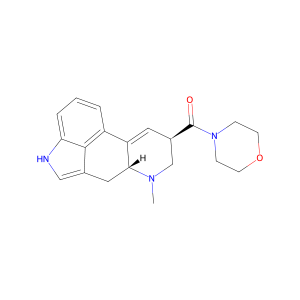
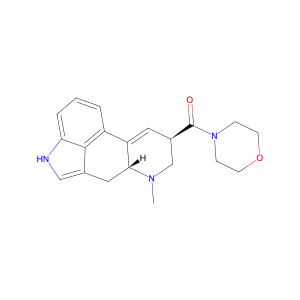
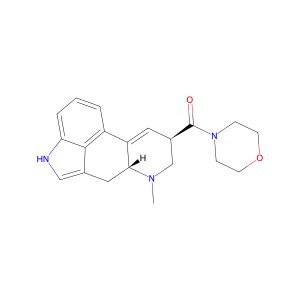
LSM-775, or lysergic acid morpholide, is a lysergamide in which the diethylamide group of LSD is replaced by a morpholine ring. It appeared on the new psychoactive substance market around 2013, but its reported human effects were inconsistent. A detailed 2018 study clarified its receptor activity and found an unusual interaction between 5-HT1A and 5-HT2A signalling.
Chemistry and identification
LSM-775 retains the ergoline core of LSD but contains a morpholide group at the carboxamide position. The morpholine ring incorporates both nitrogen and oxygen, making the amide substituent more constrained than LSD’s two flexible ethyl groups.
A powdered sample was characterised using X-ray crystallography, NMR, GC-MS, high-resolution mass spectrometry and chromatographic methods. The work provided a reliable analytical reference for a compound that had already appeared in research-chemical products (Brandt and colleagues, 2018).
Receptor pharmacology
In receptor assays, LSM-775 acted as a non-selective agonist at 5-HT1A and 5-HT2A receptors. The combination is notable because 5-HT2A activation is central to the behavioural effects of classical serotonergic psychedelics, while 5-HT1A activation can modify those responses.
In mice, LSM-775 did not produce the usual head-twitch response unless the animals were pretreated with a 5-HT1A antagonist. The authors proposed that its 5-HT1A activity suppresses or masks the behavioural response associated with 5-HT2A activation. This may explain historical descriptions of weak LSD-like effects, although no human clinical study has confirmed the explanation.
Reported effects and human evidence
Older descriptions of LSM-775 are inconsistent, ranging from weak LSD-like effects to little noticeable activity. The 2018 study concluded that the available evidence was compatible with a relatively weak psychedelic response. There are no modern controlled human trials that define its subjective effects, pharmacokinetics or duration.
Research limitations
The receptor activity of LSM-775 is better characterised than that of many little-studied lysergamides, though important questions remain. The interaction between its 5-HT1A and 5-HT2A effects has been demonstrated in an animal model, not in a controlled human study. Its acute toxic range, dependence potential and long-term effects are not established.
Related lysergamides
LSM-775 is related to LSD, LSZ, MiPLA and other amide-modified lysergamides. Its morpholine-containing amide distinguishes it from the diethylamide and azetidide structures.