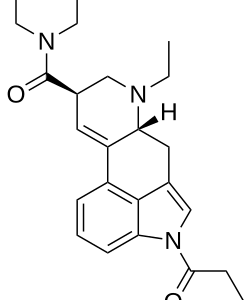
1P-ETH-LAD is an N1-propionyl derivative of ETH-LAD, a lysergamide with an N6-ethyl substitution. It combines the N1-acyl modification found in compounds such as 1P-LSD with the altered ergoline structure of ETH-LAD. The compound has been analytically characterised, and human-serum experiments indicate that it can be converted to ETH-LAD. Its human pharmacology, however, has not been established in controlled studies.
Chemistry and identification
ETH-LAD is N6-ethyl-6-norlysergic acid diethylamide. In 1P-ETH-LAD, a propionyl group is added at the N1 position. This means the compound differs from 1P-LSD at the N6 position as well as from ETH-LAD at N1.
The 2017 analytical study used GC-MS, low- and high-resolution electrospray MS, GC-solid-state infrared spectroscopy, HPLC-DAD and NMR to characterise ETH-LAD and 1P-ETH-LAD. The work made analytical data available for a compound that had appeared on the new psychoactive substance market without a prior detailed scientific description (Brandt and colleagues, 2017).
Conversion to ETH-LAD
When 1P-ETH-LAD was incubated with human serum at 37 °C, ETH-LAD formed over the observation period. The parent compound was still detectable after 24 hours in that in-vitro experiment. The authors therefore suggested that 1P-ETH-LAD may act as a prodrug for ETH-LAD, while noting that the study did not establish the process in living humans.
A broader metabolism investigation of LSD-based new psychoactive substances included 1P-ETH-LAD among nine lysergamides. It found that N-dealkylation and hydroxylation were common pathways across the group, with CYP1A2 and CYP3A4 contributing to initial metabolism (Wagmann and colleagues, 2019).
Pharmacology and reported effects
The human pharmacology of 1P-ETH-LAD has not been examined in a substantial controlled study. Its proposed conversion to ETH-LAD provides a plausible route to lysergamide activity, but does not establish the extent of conversion, the contribution of the intact parent compound or the subjective effects in people.
Descriptions of ETH-LAD or 1P-LSD offer comparisons, but do not establish the effects of 1P-ETH-LAD.
Toxicology and research gaps
Most published evidence concerns analytical chemistry and in-vitro metabolism. There is no well-characterised human toxic range, controlled dependence assessment or long-term safety study specific to 1P-ETH-LAD. Clinical interpretation is further complicated when products are identified from blotter material without biological confirmation.
Related lysergamides
1P-ETH-LAD is related to ETH-LAD, 1P-LSD, 1cP-LSD and 1cP-AL-LAD. Its combination of N1-propionyl and N6-ethyl substitutions distinguishes it from the other compounds in this group.
1P-ETH-LAD Products
Scientific Data
Structured reference fields associated with this compound.
Identity and Structure
Chemical Identifiers
Clinical Data
Legal Status
UK: Under Psychoactive Substances Act
Illegal in France