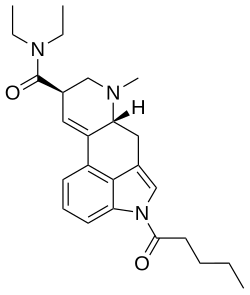
1V-LSD, also known as 1-valeroyl-LSD or 1-pentanoyl-LSD, is an N1-acyl derivative of lysergic acid diethylamide. A valeroyl group is attached to the indole nitrogen of the LSD structure. It appeared on the research-chemical market as a higher homologue of 1P-LSD and 1B-LSD. Analytical work has confirmed its identity, and mouse studies show LSD-like activity, although its conversion to LSD in humans has not been established in a controlled clinical study.
Chemistry and identification
1V-LSD retains the ergoline skeleton, N6-methyl group and N,N-diethylamide side chain of LSD. Its distinguishing feature is a five-carbon valeroyl substituent at N1. This makes it a higher homologue of 1B-LSD, which carries a butanoyl group, and 1P-LSD, which carries a propanoyl group.
A 2021 study characterised 1V-LSD using mass spectrometry, gas and liquid chromatography, NMR, Raman spectroscopy and GC-solid-state infrared analysis. The researchers also observed several isomeric forms in the tested material. They noted that sample preparation could cause hydrolysis to LSD before GC-MS analysis, an important consideration when interpreting forensic results (Brandt and colleagues, 2021).
Pharmacology and animal research
The same study measured the head-twitch response to 1V-LSD in mice, a behavioural assay associated with 5-HT2A receptor activation. The response increased with dose. Its median effective dose was 373 nmol/kg, compared with 132.8 nmol/kg for LSD in the same study. This indicates lower potency than LSD in that particular animal model, not a direct estimate of human potency.
The authors considered it likely that 1V-LSD is hydrolysed to LSD, as has been demonstrated for several other N1-acyl lysergamides. However, they explicitly noted that further work on its biotransformation and receptor pharmacology was needed to establish the mechanism more fully (Analytical and behavioural characterization of 1V-LSD).
Human effects and evidence limits
There is no substantial controlled human study defining the subjective effects, pharmacokinetics or duration of 1V-LSD. Online descriptions often compare it with LSD, but those accounts cannot distinguish the effects of the intact compound from effects that may follow conversion to LSD.
Its chemical identity and LSD-like activity in mice are established. A prodrug pathway remains plausible, but has not been confirmed clinically.
Analytical and toxicological considerations
Hydrolysis during sample preparation can complicate identification. If an N1-acyl lysergamide is converted to LSD before analysis, a laboratory may detect LSD even though the original sample contained 1V-LSD. Methods that preserve the parent compound and distinguish degradation products are important for reliable identification.
Its toxic range in humans, dependence potential and long-term effects have not been established. Findings from LSD or other acylated lysergamides provide context, but do not replace compound-specific clinical research.
Related lysergamides
1V-LSD is related to 1P-LSD, 1B-LSD, 1cP-LSD and 1D-LSD. All are modified at the N1 position, but the substituents and available evidence differ.