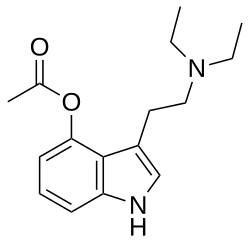
4-AcO-DET, or 4-acetoxy-N,N-diethyltryptamine, is a synthetic tryptamine with an acetoxy group at the 4-position of the indole ring. It is the acetylated analogue of 4-HO-DET and is structurally related to psilacetin, although its N,N-diethyl side chain differs from the dimethyl group in 4-AcO-DMT. Recent research has examined its serotonin-receptor activity and metabolism, but controlled human data remain limited.
Chemistry and identification
4-AcO-DET has an indole core, a 4-acetoxy substituent and two ethyl groups attached to the terminal nitrogen. It is sometimes described as the acetate ester of 4-HO-DET. This structural relationship makes ester hydrolysis a plausible metabolic pathway, but the extent and timing of conversion in humans are not known.
The compound was first synthesised in the late 1950s and later appeared in the new psychoactive substance market. Analytical studies have used chromatography and mass spectrometry to identify it in research samples and biological models.
Receptor pharmacology
A 2023 study measured the activity of 4-AcO-DET at human 5-HT1A, 5-HT2A and 5-HT2C receptors, as well as the serotonin transporter. In the 5-HT2A functional assay, it acted as an agonist with an EC50 of approximately 309 nM and an efficacy of about 79% relative to serotonin. These are in-vitro measurements and do not directly describe the intensity of human effects (Kozell and colleagues, 2023).
Metabolism research
A 2024 study investigated 4-AcO-DET in pooled human liver S9 fractions and zebrafish larvae. Several phase I metabolites and two phase II metabolites were identified in the laboratory systems. Five metabolites found in the liver preparation were also detected in the zebrafish model, while additional metabolites appeared only in the latter. The study provides potential analytical markers, but zebrafish metabolism is not a substitute for human pharmacokinetic data (Gampfer and colleagues, 2024).
The same paper found no cytotoxic effects in HepG2 cells under the tested conditions. This result is limited to that cell model and does not establish that the compound is safe in humans.
Reported effects and clinical evidence
There are few reliable human observations specific to 4-AcO-DET. Reports often compare it with other 4-substituted tryptamines, but such descriptions are anecdotal and do not establish a consistent clinical profile. Receptor and metabolism studies offer firmer evidence of its biological properties than online accounts.
Research limitations
Its receptor activity is now better characterised than its human pharmacokinetics or toxicology. There is no established human concentration-toxicity relationship, and dependence potential and long-term effects have not been adequately studied. Findings for 4-HO-DET or 4-AcO-DMT cannot be assumed to apply directly to 4-AcO-DET.
Related tryptamines
4-AcO-DET is related to 4-HO-DET, 4-AcO-DMT, 4-AcO-DiPT and other 4-substituted tryptamines. Its N,N-diethyl group distinguishes it from the dimethyl, diisopropyl and mixed-alkyl analogues.