Pyrrolidinophenones
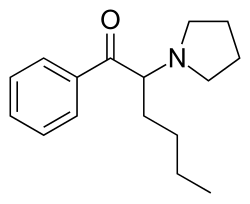
Pyrrolidinophenones are a structural subgroup of synthetic cathinones. Their molecules combine a pyrrolidine ring with a beta-keto phenethylamine framework, a pattern found in several potent stimulant compounds. Alpha-PVP, alpha-PHP and MDPV are among the best-known examples. They are often discussed together, although changes to the side chain or aromatic ring can alter their activity at monoamine transporters.
The category overlaps with pyrovalerones, which include several familiar pyrrolidine cathinones. Both sit within the broader synthetic cathinone family. The main stimulants overview compares these compounds with amphetamines, phenidates and other stimulant groups.
What the name describes
The term points to two parts of the molecule: a phenyl-containing ketone structure and a pyrrolidine ring. The beta-keto group is part of the wider cathinone framework; the nitrogen forms part of the pyrrolidine ring, giving the molecule a tertiary amine structure that distinguishes it from many other cathinones.
Members of the group vary in the length and branching of the carbon chain and in substitutions on the aromatic ring. Alpha-PVP and alpha-PHP share the pyrrolidine-containing scaffold but differ in side-chain length. MDPV has a methylenedioxy group on the aromatic ring. These differences are relevant to structure-activity research, but a shared scaffold does not guarantee the same effects.
Activity at dopamine and noradrenaline transporters
Many pyrrolidinophenones act mainly as reuptake inhibitors at DAT and NET. Blocking these transporters slows the removal of dopamine and noradrenaline from the synaptic space. In several experimental studies, their activity at the serotonin transporter (SERT) is weaker than at DAT, though the degree of selectivity varies across compounds.
This is not the same mechanism commonly associated with amphetamine or with cathinones that act as transporter substrates. A study of second-generation pyrovalerone cathinones compared activity at human monoamine transporters and found that changes to the alpha-carbon chain could alter DAT and NET inhibition. A separate structure-activity study of alpha-PHP analogues examined the effect of aromatic substitutions on dopamine-transporter inhibition.
How the category overlaps with pyrovalerones
Alpha-PVP, alpha-PHP and MDPV are regularly listed as pyrrolidinophenones. Depending on the source, they may also appear under pyrovalerones or simply under synthetic cathinones. These labels describe overlapping chemical groups at different levels of classification, so their use need not be contradictory.
“Pyrrolidinophenone” emphasises a structural motif; “pyrovalerone” refers to a related family with a particular history and set of analogues; “cathinone” identifies the broader beta-keto framework. For this directory, pyrrolidinophenones are treated as the structural group and pyrovalerones as a closely related, overlapping category.
Acute effects and reported harms
Strong inhibition of dopamine and noradrenaline reuptake can produce pronounced stimulant effects. Reports describe agitation, insomnia, tachycardia, hypertension, hyperthermia, paranoia and psychosis. Severe poisonings have also involved seizures, cardiovascular events, rhabdomyolysis and kidney injury.
These reports need to be read in context. Some involve more than one substance, and the severity of an outcome depends on the compound and circumstances of exposure. Laboratory measurements of transporter potency are not direct measures of human toxicity; they describe one mechanism under controlled conditions, not an individual’s response.
What is known from laboratory and forensic work
For several pyrrolidinophenones, researchers have useful in-vitro data on DAT, NET and SERT, along with animal studies and a growing forensic record. Human pharmacokinetic data, controlled clinical studies and long-term outcome research remain much more limited. New analogues can appear before their metabolism and toxicology have been properly characterised.
Laboratories use GC-MS, LC-MS/MS and high-resolution mass spectrometry to identify these compounds. Closely related analogues may require validated chromatographic methods and reference standards. An identification result does not show how much of the compound is present, whether other drugs have been mixed in or whether the sample is safe.
Questions about the group
Are pyrrolidinophenones a type of cathinone?
Yes. They are a structural subgroup of synthetic cathinones, distinguished by the pyrrolidine ring that incorporates the amine nitrogen.
Are all pyrrolidinophenones also called pyrovalerones?
The terms overlap, particularly for compounds such as alpha-PVP and MDPV, but they are not used with exactly the same scope in every source. It is helpful to state whether a classification is structural or historical.
Do all members have the same transporter profile?
No. Many show strong DAT and NET inhibition, but the relative activity varies with molecular structure. Findings for one compound should not be assumed to describe every member of the group.
Showing all 3 results
a-PHP
Price range: $390.00 through $8,300.00Select options This product has multiple variants. The options may be chosen on the product page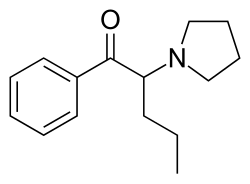
a-PVP
Price range: $390.00 through $8,300.00Select options This product has multiple variants. The options may be chosen on the product page
MDPV
Price range: $390.00 through $8,300.00Select options This product has multiple variants. The options may be chosen on the product page