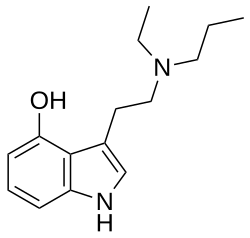
4-HO-EPT, or 4-hydroxy-N-ethyl-N-propyltryptamine, is a synthetic tryptamine with a hydroxy group at the 4-position of the indole ring. Its terminal nitrogen carries one ethyl and one propyl group. It is part of the broader family of 4-substituted tryptamines related to psilocin, but there is little human clinical information specific to the compound.
Chemistry and identification
4-HO-EPT combines the 4-hydroxyindole structure with an unsymmetrical N-ethyl-N-propyl substitution. It is distinct from 4-HO-MET, which has a methyl and ethyl group, and from 4-HO-DPT, which has two propyl groups.
The US FDA Substance Registration System records 4-HO-EPT as the preferred substance name and lists 4-hydroxy-N-ethyl-N-propyltryptamine among its synonyms. Database registration confirms a chemical identity; it does not indicate regulatory approval or a recognised medical use (FDA Substance Registration System: 4-HO-EPT).
Receptor research
A comparative study of tryptamine psychedelics included 4-HO-EPT in receptor-binding experiments. The reported binding data showed measurable interaction with several serotonin receptor subtypes, including 5-HT2A. The study was designed to compare receptor affinity, not to establish human subjective effects or clinical safety (Receptor binding profiles for tryptamine psychedelics, 2022).
These measurements go beyond predictions based on structure, but do not fully establish the compound’s functional activity. Binding affinity alone cannot show whether a compound acts as a full agonist, partial agonist or antagonist in a particular signalling pathway.
Reported effects and clinical evidence
There are few reliable human reports that can be independently linked to analytically confirmed 4-HO-EPT. No controlled clinical study has established a characteristic experience, duration or adverse-event pattern. Descriptions of 4-HO-MET, 4-HO-DPT or other analogues should not be presented as confirmed effects of 4-HO-EPT.
Toxicology and research limitations
Human metabolism, acute toxic range, dependence potential and long-term effects remain poorly characterised. The receptor-binding study provides an initial pharmacological reference, but additional functional assays and clinical toxicology would be needed to establish a more complete profile.
Its chemical identity is established, but receptor data are limited and human evidence remains scarce.
Related tryptamines
4-HO-EPT is related to 4-HO-MET, 4-HO-DPT, 4-HO-DET and other 4-hydroxy tryptamines. Its mixed ethyl-propyl substitution distinguishes it from the symmetrical N,N-dialkyl compounds.