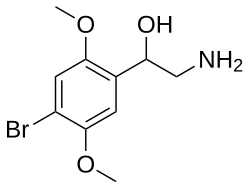
β-OH-2C-B, also written bOH-2C-B or BOHB, is a beta-hydroxylated analogue of 2C-B. Although listed under Tryptamines in the catalogue, it is not chemically a tryptamine. Its structure belongs to the substituted phenethylamine family: the side chain contains an amino alcohol attached to a brominated, dimethoxy-substituted aromatic ring.
Chemistry and identification
The systematic name is 2-amino-1-(4-bromo-2,5-dimethoxyphenyl)ethanol. The compound retains the 4-bromo-2,5-dimethoxyphenyl ring found in 2C-B, but the side chain has an additional hydroxyl group at the beta carbon. PubChem records the structure under BOH-2C-B and lists beta-hydroxy-2C-B among its synonyms (PubChem compound record: BOH-2C-B).
The hydrochloride salt is also registered in the US Global Substance Registration System. These records establish the chemical identity and naming variants; they do not establish a medical use or a well-characterised pharmacological profile (NCATS Global Substance Registration System: BOH-2C-B hydrochloride).
Relationship to 2C-B
The most direct structural comparison is with 2C-B. Both compounds contain the same brominated 2,5-dimethoxyphenyl ring, but β-OH-2C-B has an extra hydroxyl group on the side chain. This modification changes the molecule’s polarity and makes the side chain an amino alcohol, unlike the side chain in 2C-B.
That structural relationship is useful for identification, but it does not show that β-OH-2C-B has the same receptor activity or subjective effects as 2C-B.
Pharmacology and reported effects
Published information about the pharmacology of β-OH-2C-B is very limited. The available public-health summaries and chemical records do not provide a robust receptor-binding profile, functional assay or controlled human study. Its classification as a 2C-B analogue does not establish the same psychedelic activity.
Reliable human evidence is too limited to establish a characteristic experience or a clinical syndrome. Reports about 2C-B or other substituted phenethylamines should not be transferred to β-OH-2C-B without direct analytical and pharmacological evidence.
Toxicology and research gaps
No well-characterised human case series, metabolism study or controlled toxicity assessment specific to β-OH-2C-B was identified in the sources reviewed here. Its acute toxic range, dependence potential and long-term effects remain unknown. A Canadian government overview likewise noted that little information was available in the literature for this substance (Health Canada: New psychoactive substances, 2022 overview).
Related compounds
β-OH-2C-B is related structurally to 2C-B and other substituted phenethylamines. It should not be grouped chemically with indole-based tryptamines such as DMT, DET or DiPT.