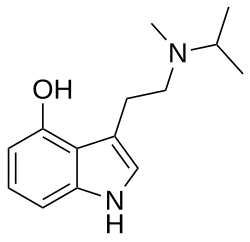
4-HO-MiPT, also known as miprocin, is a synthetic 4-hydroxy tryptamine with a methyl-isopropyl substitution on the terminal nitrogen. It is structurally related to psilocin, but the different nitrogen substituents give it a distinct receptor profile. Recent laboratory work has examined its activity at serotonin receptors and the serotonin transporter, while a separate 2024 study linked a human intoxication case to preclinical findings for the related compound 5-MeO-MiPT, not 4-HO-MiPT.
Chemistry and identification
4-HO-MiPT is 4-hydroxy-N-methyl-N-isopropyltryptamine. The hydroxy group is attached directly to the 4-position of the indole ring. Its acetylated analogue is 4-AcO-MiPT, while the corresponding methoxy compound is 4-MeO-MiPT. These are separate molecules. Their shared N-methyl-N-isopropyl side chain does not imply identical effects.
Receptor pharmacology
4-HO-MiPT acts at several serotonin receptor subtypes, including 5-HT2A. A 2023 receptor-screening study reported a 5-HT2A binding affinity of about 114 nM and found agonist activity in functional assays. It also showed activity at other serotonin receptors and measurable interaction with targets outside the serotonin family (Receptor binding profiles for tryptamine psychedelics, 2023).
A more detailed 2026 study compared 4-HO-MiPT with its acetoxy and methoxy analogues. In mice, 4-HO-MiPT produced a dose-related head-twitch response, a behavioural marker associated with 5-HT2A activation. Its estimated ED50 was 0.75 mg/kg in that model. The study also found that serotonin-transporter inhibition differed between the hydroxy and methoxy compounds, helping explain why closely related tryptamines can produce different behavioural results (Glatfelter and colleagues, 2026).
Reported effects
Human accounts are largely anecdotal and commonly describe changes in visual perception, colour and tactile sensation, alongside changes in mood and thought. Some accounts also mention anxiety, nausea, muscle tension or difficulty sleeping. These descriptions do not come from controlled trials and cannot establish how often a particular effect occurs.
Clinical and toxicological findings
A 2024 paper on 5-MeO-MiPT, a related but distinct compound, examined a human poisoning case alongside animal experiments. The researchers found that 5-MeO-MiPT altered sensorimotor responses in mice and, at high experimental exposures, affected stimulated motor activity and cardiorespiratory measures. The authors considered the findings relevant to the human case, but the animal results should not be read as a direct measure of human toxicity (Bassi and colleagues, 2024).
For 5-MeO-MiPT, the same paper reviewed predicted metabolic pathways, including N-dealkylation, O-demethylation and hydroxylation. Earlier human liver-microsome and case-sample work identified 5-MeO-NIPT and 5-OH-MiPT among the metabolites proposed for detecting 5-MeO-MiPT exposure (Grafinger and colleagues, 2018).
Early clinical development
In September 2025, Mindstate Design Labs announced Phase I results for MSD-001, an oral formulation of 5-MeO-MiPT. These results concern 5-MeO-MiPT, not 4-HO-MiPT. The company described the formulation as well tolerated and reported no serious adverse events. It also reported psychoactive effects without the hallucinations usually associated with classic psychedelics. These are sponsor-reported topline results, not evidence of established therapeutic efficacy; a full peer-reviewed report is needed to assess the findings independently (Mindstate Design Labs, Phase I announcement, 2025).
What remains uncertain
There is no large controlled clinical literature defining the safety, dependence potential or long-term effects of 4-HO-MiPT. Receptor assays and animal studies provide context, as do intoxication reports involving related compounds, but they do not establish a reliable human concentration-toxicity relationship for 4-HO-MiPT.
Related tryptamines
4-HO-MiPT is related to 4-AcO-MiPT, 4-HO-MET, 4-HO-DET and 5-MeO-MiPT. Its 4-hydroxy group and methyl-isopropyl side chain distinguish it from these analogues.