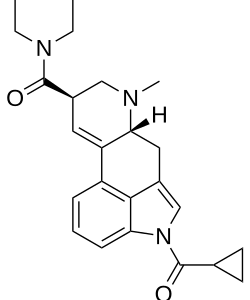
1cP-LSD, or 1-cyclopropanoyl-LSD, is an N1-acyl derivative of lysergic acid diethylamide. A cyclopropanecarbonyl group is attached to the indole nitrogen while the rest of the LSD structure remains intact. It appeared on the research-chemical market in the late 2010s and has since been examined in analytical, metabolic and animal-behaviour studies. The available findings suggest that it can be converted to LSD, but controlled human studies are lacking.
Chemistry and identification
1cP-LSD retains the ergoline skeleton, N6-methyl group and N,N-diethylamide side chain of LSD. The cyclopropanoyl group at N1 places it in the same broad category as 1P-LSD and 1B-LSD, although the acyl substituent is structurally different.
The compound has been characterised using GC-MS, LC-MS, high-resolution mass spectrometry, NMR and infrared spectroscopy. It has been identified in blotter and pellet samples. Researchers also observed degradation products during GC-MS analysis, showing that the analytical conditions themselves can affect the material being measured (Brandt and colleagues, 2020).
Conversion to LSD
When 1cP-LSD was incubated with human serum, LSD was formed over time. This supports the possibility that 1cP-LSD acts as a prodrug, with deacylation releasing LSD after exposure. The result is consistent with earlier findings for 1P-LSD and other N1-acyl lysergamides, although the extent and timing of conversion in people have not been established in a controlled clinical study.
Behavioural research
In mice, 1cP-LSD produced a dose-related head-twitch response, a behavioural marker associated with 5-HT2A receptor activation. Its measured potency in this test was broadly comparable to that reported for 1P-LSD. The authors interpreted the result as evidence of LSD-like activity in the animal model, while noting that clinical studies would be needed to determine the effects in humans (Return of the lysergamides, Part VI).
Human effects and limitations
Neither the subjective effects nor the pharmacokinetics of 1cP-LSD have been established in a substantial controlled human study. Anecdotal descriptions often compare it with LSD, but the serum-hydrolysis findings suggest that these comparisons may reflect LSD formed in the body, rather than the activity of the intact parent compound alone.
The available research does not establish a reliable concentration-toxicity relationship, dependence profile or long-term safety record.
Analytical considerations
Some N1-acyl lysergamides can lose their acyl group during sample preparation or GC-MS analysis. A laboratory may therefore detect LSD even when the original material contained an acylated derivative. Reliable identification requires methods that account for this possibility and distinguish degradation during analysis from metabolism in a biological sample.
Related lysergamides
1cP-LSD is related to 1P-LSD, 1B-LSD, 1D-LSD and 1Fe-LSD. All are modified at N1, but the available evidence for metabolism and biological activity differs between them.
1cP-LSD Products
Scientific Data
Structured reference fields associated with this compound.
Identity and Structure
Chemical Identifiers
Clinical Data
Pharmacokinetics
Legal Status
BR: Class F2 (Prohibited psychotropics)
CA: Unscheduled.
DE: NpSG (Industrial and scientific use only)
UK: Under Psychoactive Substances Act