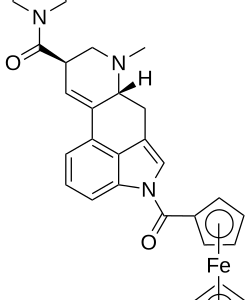
1Fe-LSD, also known as 1-(ferrocenecarbonyl)-LSD or SYN-L-234, is an organometallic lysergamide derivative. A ferrocenecarbonyl group is attached to the N1 position of the LSD structure. The compound appears in a 2024 patent covering substituted ergoline prodrugs and later became visible in online research-chemical listings. Independent peer-reviewed pharmacology and clinical data specific to 1Fe-LSD remain very limited.
Chemistry and patent disclosure
1Fe-LSD retains the ergoline skeleton and N,N-diethylamide group of LSD, but the N1 substituent contains ferrocene, an iron-containing organometallic unit. The patent identifies the compound as SYN-L-234 and provides its analytical description, including proton NMR data. It also lists a related ferrocenecarbonyl derivative of AL-LAD (WO2024028495A1, Prodrugs of substituted ergolines).
This is an unusual modification among lysergamides. Most better-studied N1-acyl derivatives carry small organic groups such as acetyl, propionyl, butanoyl or cyclopropanoyl. The ferrocenecarbonyl group introduces an organometallic component, so its chemical behaviour should not be assumed to match that of simple aliphatic acyl analogues.
Pharmacology and proposed prodrug role
The patent places 1Fe-LSD within a broader group of substituted ergolines described as prodrugs. It reports animal experiments in which a panel of modified lysergamides was assessed for conversion to LSD and for LSD-like behavioural responses. However, the patent is not an independent peer-reviewed pharmacology paper, and it does not replace compound-specific clinical research.
There is no published human receptor-binding study establishing the affinity or efficacy of 1Fe-LSD at 5-HT2A or other serotonin receptors. Its conversion to LSD in humans has not been confirmed in a controlled clinical pharmacokinetic study.
Reported effects and clinical evidence
No controlled human study has established a reliable subjective effect profile for 1Fe-LSD. Online descriptions often compare it with LSD or other N1-acyl lysergamides, but such comparisons are not a substitute for clinical observations, particularly given the unusual ferrocenecarbonyl group.
Research limitations
The patent provides a structural record and reports exploratory experimental work, but independent scientific research has yet to fully establish 1Fe-LSD’s metabolism, receptor pharmacology, acute toxicity or long-term effects. The presence of an iron-containing substituent also makes it inappropriate to infer the compound’s safety from the lysergamide core alone.
Until independent studies are available, claims about potency, duration, conversion to LSD and clinical risk remain unconfirmed.
Related lysergamides
1Fe-LSD is related to 1P-LSD, 1B-LSD, 1cP-LSD, 1D-LSD and 1S-LSD. Its defining feature is the ferrocenecarbonyl group at N1.
1Fe-LSD Products
Scientific Data
Structured reference fields associated with this compound.