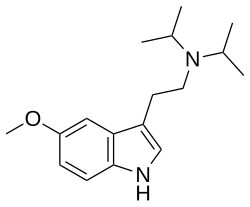
5-MeO-DiPT, also known as foxy or foxy methoxy, is a synthetic tryptamine with a methoxy group at the 5-position of the indole ring and two isopropyl groups attached to the terminal nitrogen. It appeared on recreational drug markets in the late 1990s and has been associated with acute intoxications, including gastrointestinal, neurological and cardiovascular symptoms. Its human metabolism has been studied, and a fatal poisoning case has been reported.
Chemistry and history
5-MeO-DiPT is 5-methoxy-N,N-diisopropyltryptamine. The two isopropyl groups distinguish it from 5-MeO-MiPT, which carries one methyl and one isopropyl group, and from 5-MeO-DMT, which has two methyl groups. It has no recognised therapeutic use in the United States and is listed by the DEA as a Schedule I controlled substance (DEA drug evaluation: 5-MeO-DiPT, 2025).
Pharmacology
5-MeO-DiPT is a serotonergic psychedelic. Animal behavioural studies have found effects resembling those produced by other hallucinogens, while human reports describe changes in perception and sensory processing. The DEA notes that the compound has been encountered in powder, tablet and capsule form, and that its forensic laboratory reports peaked in 2011 before falling substantially in later years (DEA, 2025).
Reported effects and clinical concerns
Human descriptions include altered sensory perception, hallucinations, emotional changes and increased talkativeness. Adverse reactions reported in clinical and forensic sources include nausea, vomiting, muscle hyperreflexia, agitation and cardiovascular symptoms. The DEA’s 2025 review records emergency-department admissions and one death reported to the FDA’s adverse-event system in 2024. That report alone does not establish 5-MeO-DiPT as the sole cause of death.
Metabolism
Human urine studies identified three principal metabolic pathways: O-demethylation to 5-hydroxy-DiPT, hydroxylation of the aromatic ring and N-deisopropylation to 5-MeO-NIPT. The hydroxylated metabolites were often more abundant than the N-dealkylated product. Some metabolites were further conjugated with sulfate or glucuronic acid (Kamata and colleagues, 2006).
Human liver-microsome research found that CYP2D6 was the main enzyme involved in O-demethylation, while several other CYP enzymes contributed to N-deisopropylation (Oxidative metabolism of 5-MeO-DiPT, 2006).
Fatal poisoning and limitations
A forensic case report described a fatal poisoning in which 5-MeO-DiPT and its metabolites were identified in blood and urine. The authors reported elevated concentrations of the parent compound and its major metabolites (A fatal poisoning with 5-MeO-DiPT, 2006).
Although its metabolism has been studied in some detail, controlled human studies defining the acute toxic range, dependence potential and long-term effects remain limited. The DEA also notes that use reports have declined sharply since their 2011 peak.
Related tryptamines
5-MeO-DiPT is related to 5-MeO-MiPT, 5-MeO-DMT and 5-MeO-DALT. Its N,N-diisopropyl side chain distinguishes it from the methyl and allyl analogues.