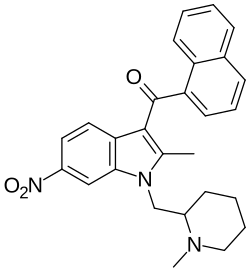
AM-1221 is a synthetic cannabinoid research compound from the naphthoylindole family. It differs from AM-1220 by a methyl and nitro substitution on the indole ring, and it is best known for its strong selectivity toward the CB2 cannabinoid receptor. Unlike many synthetic cannabinoids developed for recreational markets, AM-1221 has primarily been studied as a selective pharmacological tool.
Chemistry and relationship to AM-1220
AM-1221 is 1-[(N-methylpiperidin-2-yl)methyl]-2-methyl-3-(naphthalen-1-oyl)-6-nitroindole. It shares the naphthoylindole and methylpiperidinylmethyl features of AM-1220, but has additional methyl and nitro substituents on the indole core. These changes are associated with a substantially different receptor-selectivity profile.
The FDA Substance Registration System records AM-1221 as a distinct chemical substance and lists its CAS number and structural identity (FDA Substance Registration System: AM-1221).
Pharmacology
AM-1221 is described as a highly selective CB2 receptor agonist. Published binding data report a Ki of approximately 0.28 nM at CB2 and 52.3 nM at CB1, indicating a marked preference for the peripheral receptor subtype. This profile distinguishes it from many recreational synthetic cannabinoids that are designed or selected for strong central CB1 activity (Emerging drugs of abuse: current perspectives on synthetic cannabinoids, 2015).
CB2 receptors are expressed prominently in immune and peripheral tissues and have been investigated in pain and inflammatory pathways. Selective CB2 agonism does not imply the same intoxicating effects as strong CB1 activation.
Effects in experimental research
AM-1221 has been used as a pharmacological tool in studies examining CB2-mediated signalling and analgesia. Its receptor selectivity makes it useful for separating peripheral CB2 effects from central CB1-mediated responses in experimental models.
Neither a substantial body of human accounts nor a controlled clinical trial establishes its subjective effects. Its classification alone therefore gives no basis for describing AM-1221 as a conventional cannabis-like recreational drug.
Toxicity and research limitations
Human toxicology data for AM-1221 are very limited. Its acute toxic range, metabolism, dependence potential and long-term effects have not been adequately characterised in people. The available pharmacology is based primarily on receptor-binding and preclinical research.
AM-1221 should not be confused with AM-1220. Despite their similar names and shared naphthoylindole scaffold, AM-1221 is strongly CB2-selective, while AM-1220 has a more pronounced CB1 profile.
Related compounds
AM-1221 is related to AM-1220, AM-1241 and other experimental CB2-selective cannabinoid ligands. Its nitro-substituted indole structure distinguishes it from the unsubstituted AM-1220 scaffold.

Reviews
There are no reviews yet.