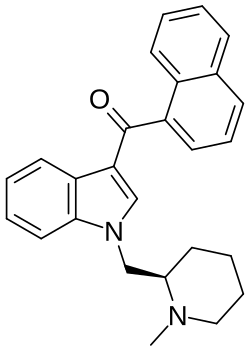
AM-1220 is an aminoalkylindole synthetic cannabinoid developed as a research ligand for cannabinoid receptors. It belongs to the naphthoylindole family and contains a methylpiperidinylmethyl group attached to the indole nitrogen. It has been detected in herbal smoking mixtures and shows strong CB1 receptor activity in laboratory studies, but there is little clinical information about its effects in humans.
Chemistry and identification
AM-1220 is a naphthoylindole with a 1-naphthoyl group at the 3-position of the indole and an N-(1-methylpiperidin-2-yl)methyl substituent. It is chemically distinct from AM-1221, which has a nitro-substituted indole core, and from AM-1248, which contains an adamantoyl group.
The UNODC database records AM-1220 as a synthetic cannabinoid receptor agonist and lists its full chemical identity and molecular formula. It was reported in a herbal smoking mixture in Germany in 2011 (UNODC substance record: AM-1220; EUDA: Synthetic cannabinoids in Europe).
Pharmacology
AM-1220 has strong affinity for the CB1 receptor. Published binding values vary across assay systems, with one early report giving a CB1 Ki of 3.88 nM and a weaker CB2 affinity of 73.4 nM. A later receptor study confirmed CB1 activation and THC-like effects in animal discrimination tests, although its CB2 signalling was weaker than that of several other aminoalkylindoles (Marusich and colleagues, 2018).
Some reference sources report markedly different binding values, reflecting differences in receptor preparations and assay methods. These figures should therefore be understood as experimental measurements rather than a direct ranking of human potency.
Reported effects
Reliable human accounts are too limited to establish a characteristic AM-1220 experience. Its CB1 activity is consistent with cannabimimetic effects, but neither controlled human studies nor a well-documented clinical case series has established typical subjective effects.
Reports involving other naphthoylindoles include altered perception, sedation, agitation and impaired coordination. These class-level observations should not be presented as confirmed effects of AM-1220 itself.
Toxicity and research limitations
AM-1220 has appeared in seized herbal products, but its human toxicology is poorly documented. There are no robust clinical data defining its acute toxic range, metabolism, dependence potential or long-term effects. Animal receptor studies demonstrate pharmacological activity but cannot establish the severity of human intoxication.
AM-1220 should also be distinguished from the AM-1220 azepane isomer, a separate structure listed by UNODC. Similar names do not mean that the two compounds have identical pharmacology.
Related compounds
AM-1220 is related to AM-1221, AM-1248, AM-2201 and other aminoalkylindole cannabinoids. Its naphthoyl group and methylpiperidinylmethyl side chain distinguish it from the adamantoyl and fluoropentyl analogues.

Reviews
There are no reviews yet.