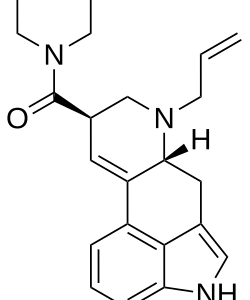
AL-LAD, or N6-allyl-6-norlysergic acid diethylamide, is a lysergamide closely related to LSD. Its structure differs by replacement of LSD’s N6-methyl group with an allyl group. The compound was first synthesised in the 1970s and appeared on the research-chemical market decades later. Analytical studies and animal experiments have confirmed LSD-like activity, although human evidence is far more limited than for LSD itself.
Chemistry and history
AL-LAD retains the ergoline framework and N,N-diethylamide group of LSD. The change is at the N6 position, where an allyl substituent replaces the methyl group. It is therefore an N6-substituted lysergamide, not an N1-acyl derivative such as 1P-LSD or 1cP-LSD.
The compound was synthesised in the 1970s as part of research into lysergic acid amides. It was later identified in powdered material and blotter products sold as new psychoactive substances. A detailed 2017 paper documented its analytical profile using NMR, GC-MS, high-resolution mass spectrometry and chromatographic methods (Brandt and colleagues, 2017).
Pharmacology
AL-LAD has high affinity for the 5-HT2A receptor, a central target involved in the effects of classical serotonergic psychedelics. Earlier receptor-binding studies reported low-nanomolar affinity. In animal drug-discrimination experiments, AL-LAD substituted for LSD, supporting a shared serotonergic mechanism.
In the mouse head-twitch response assay, AL-LAD produced a dose-related response with an estimated ED50 of 174.9 nmol/kg. LSD’s ED50 in the same comparison was 132.8 nmol/kg. This indicates somewhat lower potency in that particular animal model; it should not be read as a direct comparison of human potency (Return of the lysergamides, Part II, 2017).
Reported effects
Human evidence comes largely from self-reports and small observational datasets, which commonly describe changes in visual perception, colour, pattern recognition, mood and thought. Some reports also mention anxiety, nausea, physical discomfort or difficulty sleeping. These accounts are not controlled clinical observations and cannot show how often each effect occurs.
Clinical evidence and research limitations
There is no large controlled clinical literature defining AL-LAD’s pharmacokinetics, acute toxic range or long-term effects. Its receptor activity and animal behavioural profile are reasonably well documented, but they cannot establish clinical safety. The available human reports are too limited to provide a reliable concentration-toxicity relationship or a clear assessment of dependence potential.
Related lysergamides
AL-LAD is related to ETH-LAD, 1P-AL-LAD, 1cP-AL-LAD and LSD. Its N6-allyl group distinguishes it from the N6-ethyl analogue ETH-LAD and from lysergamides modified at N1.