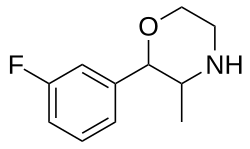
3-Fluorophenmetrazine (3-FPM) is a synthetic stimulant related to phenmetrazine. It belongs to the morpholine-based phenmetrazine family rather than the cathinones, and carries a fluorine atom at the 3-position of the phenyl ring. Laboratory studies show that it releases dopamine and norepinephrine through monoamine transporters. Human evidence is limited to anecdotal reports and a small number of adverse-event cases.
Chemistry and history
3-FPM is also known as 3-fluorophenmetrazine, 3F-phenmetrazine and PAL-593. Its structure is based on phenmetrazine, an amphetamine-type stimulant with a morpholine ring. The fluorine substituent distinguishes it from the parent compound and from the 2- and 4-fluoro positional isomers.
3-FPM appeared on the new psychoactive substance market in the 2010s. The World Health Organization reviewed it in 2020 and recommended continued surveillance. At that time, it was not under international control and had no recognised therapeutic use (WHO critical review of 3-fluorophenmetrazine, 2020).
Pharmacology
3-FPM acts as a substrate-type releaser at the dopamine, norepinephrine and serotonin transporters. In experiments using human transporter-expressing cells and rat brain synaptosomes, it produced monoamine efflux, with stronger activity at dopamine and norepinephrine transporters than at the serotonin transporter. This profile resembles phenmetrazine and is closer to amphetamine-like releasers than to cocaine-like uptake blockers (Fluorinated phenmetrazines and monoamine transporters, 2017).
Reported effects
The PsychonautWiki profile of 3-FPM and reports summarised by WHO describe stimulation, euphoria, increased energy, talkativeness and wakefulness. Some accounts mention improved concentration and motivation, while others describe anxiety, sweating, jaw clenching and difficulty sleeping.
Short-lived effects and rapid tolerance have been described in user reports, sometimes alongside repeated use over a longer period. These observations are anecdotal and do not establish a consistent time course or a controlled comparison with phenmetrazine.
Adverse reactions and clinical evidence
The WHO review summarised reports of tachycardia, reduced level of consciousness, agitation, anxiety and delirium. Less frequently, reports included hypertension, kidney injury and fatal intoxication. The contribution of 3-FPM to the more serious cases was not always clear, particularly where the full exposure history was uncertain.
One published forensic report detected 3-FPM in the blood of a young man involved in a road traffic accident. The report did not describe a clear clinical syndrome at the time of sampling, illustrating the limits of drawing conclusions from a positive toxicology result alone.
Research limitations
No controlled clinical trials or formal toxicology studies have established the safety of 3-FPM. The transporter studies explain its stimulant mechanism, but do not define a human toxic range or the long-term consequences of repeated exposure. The WHO recommended surveillance because its abuse potential was plausible, while the available evidence remained insufficient to quantify the scale of public-health harm.
Related compounds
3-FPM is related to Phenmetrazine and the positional isomers 2-FPM and 4-FPM. It is chemically distinct from pyrrolidinophenone cathinones such as α-PVP and MDPV.
Reviews
There are no reviews yet.