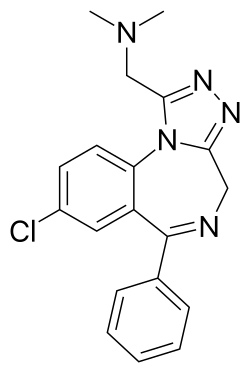
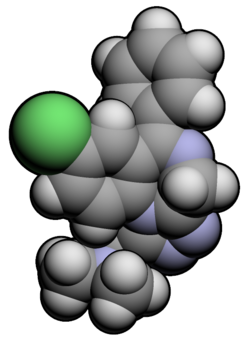

Adinazolam is a synthetic triazolobenzodiazepine developed in the 1970s as a possible treatment for anxiety and mood disorders. It was investigated in clinical studies but never approved as a medicine. The compound is converted rapidly in the body to N-desmethyladinazolam, an active metabolite that appears to account for much of its benzodiazepine-like activity. Adinazolam later emerged on the illicit drug market, where it has been detected in counterfeit tablets and mixed-drug toxicology cases.
Development and chemistry
Adinazolam was developed as part of research into triazolobenzodiazepines, a group that includes compounds such as alprazolam and triazolam. Its structure contains a triazole ring fused to the benzodiazepine system, with a dimethylaminomethyl side chain. Unlike many designer benzodiazepines, it has a history of formal clinical investigation, although it never received marketing authorisation.
Clinical trials examined adinazolam for depression, anxiety and panic disorder. Results for antidepressant effects were mixed: one study reported a moderate benefit, while another found that the effect was not sustained throughout the treatment period. The compound was not approved by the US Food and Drug Administration (WHO critical review, 2022).
Pharmacology and metabolism
Adinazolam binds to the benzodiazepine site of the GABAA receptor, enhancing the inhibitory action of GABA. In animal studies it showed anxiolytic, anticonvulsant and antidepressant-like properties. Its affinity for the benzodiazepine receptor is moderate, with little activity reported at several other major receptor systems.
After administration, adinazolam is converted extensively to N-desmethyladinazolam (NDMAD). This metabolite has stronger benzodiazepine activity than the parent compound and is thought to mediate much of the clinical effect. NDMAD is subsequently converted to didesmethyladinazolam. Human pharmacokinetic studies found that both adinazolam and NDMAD can cause sedation and measurable impairment of psychomotor performance (Fleishaker and colleagues, 1990).
Effects in humans
Unlike many newer designer benzodiazepines, adinazolam has been studied in controlled clinical settings. The effects reported in those studies were consistent with benzodiazepine activity, particularly sedation and reduced psychomotor performance. Drowsiness and dizziness were among the more frequently reported adverse effects.
Clinical testing also found dose-related changes in memory and performance on cognitive tasks. In one study involving recreational sedative users, participants reported subjective effects described as a mental and physical “high” more often than with placebo. There is little reliable information about non-medical use outside these early studies.
Psychological effects
Adinazolam was investigated for its anxiolytic and antidepressant properties. The available evidence supports an anxiety-reducing effect typical of benzodiazepines, but does not establish it as an effective antidepressant. A report of manic symptoms in participants with bipolar disorder raised a concern, although another clinical study did not reproduce that finding.
Adverse effects and dependence
Clinical studies most often reported sedation, drowsiness, dizziness, memory impairment and reduced psychomotor performance. The available trials did not show consistent changes in blood pressure, pulse or respiration, but they were not designed to establish the safety of long-term non-medical use.
There are no controlled studies that define the dependence potential of adinazolam. Its action at the benzodiazepine receptor and the effects of its active metabolite suggest that dependence and withdrawal could resemble those associated with other benzodiazepines. The compound has been detected in some post-mortem cases alongside opioids and other sedatives, but those reports do not show that adinazolam caused the deaths.
Appearance on the illicit market
Adinazolam was first identified in recreational-market samples in Europe in 2015. It has since been reported in several countries and has appeared in counterfeit pharmaceutical products, including tablets sold as alprazolam. The WHO review found limited evidence of widespread use and recommended continued surveillance rather than international scheduling at that time.
Related compounds
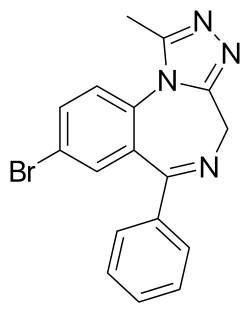
Adinazolam belongs to the triazolobenzodiazepine group and is structurally related to Alprazolam and Triazolam. Its active metabolite, N-desmethyladinazolam, contributes to its pharmacology and needs to be distinguished from the parent compound.

Reviews
There are no reviews yet.