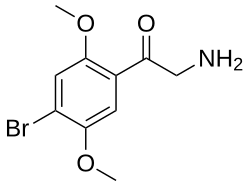
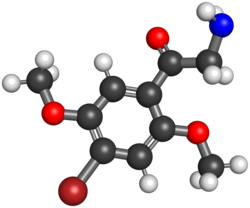
bk-2C-B, also known as beta-keto-2C-B or beta-ketone 2C-B, is a synthetic cathinone-like derivative of the psychedelic phenethylamine 2C-B. It retains the brominated 2,5-dimethoxyphenyl ring but has a ketone group on the side chain. The compound has been identified in seized tablets and examined in laboratory studies, which found weak activity at the 5-HT2A receptor and possible monoamine oxidase interactions.
Chemistry and identification
bk-2C-B is the beta-keto analogue of 2C-B. The addition of a carbonyl group converts the phenethylamine side chain into a cathinone-like structure. It should not be confused with 2C-B itself or with 25B-NBOMe, which has a different N-benzyl substitution.
The compound was identified in a seized tablet and characterised using GC-MS, LC-high-resolution mass spectrometry and nuclear magnetic resonance. The study highlighted the analytical difficulties of identifying bk-2C-B when no certified reference standard was available (Frison and colleagues, 2015).
Pharmacology
In a comparative receptor assay, bk-2C-B showed weak partial agonist activity at the 5-HT2A receptor. Its measured potency and efficacy were markedly lower than those of 2C-B in the same experimental system. This suggests that the beta-keto modification substantially changes its interaction with the receptor (Canal and colleagues, 2018).
A 2019 study screened bk-2C-B alongside other 2C compounds for inhibition of monoamine oxidase A and B. The study detected weak MAO-B inhibition by bk-2C-B, while MAO-A inhibition was not detected under the conditions used. The authors cautioned that the clinical significance of MAO inhibition by most of the tested compounds was unknown (Wagmann and colleagues, 2019).
Subjective effects
The PsychonautWiki profile of bk-2C-B offers only limited anecdotal descriptions. No controlled human studies define its subjective effects, and it would be misleading to assume that it produces the same psychedelic experience as 2C-B.
Its weak 5-HT2A activity in vitro differs from the more pronounced activity of the parent compound. Reports about 2C-B or other cathinones cannot establish the visual, cognitive or physical effects of bk-2C-B.
Toxicity and research limitations
No well-characterised clinical case series has established the acute toxicity, metabolism, dependence potential or long-term effects of bk-2C-B. Detection in a seized tablet confirms its presence in drug materials, without establishing its clinical safety.
The receptor and MAO studies are laboratory experiments. They do not establish how the compound behaves in the human body or whether the observed enzyme interactions are clinically relevant.
Related compounds
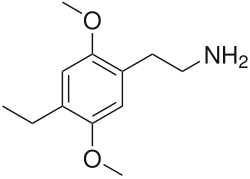
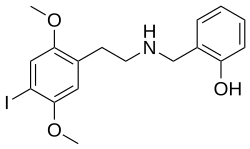
bk-2C-B is related to 2C-B and other beta-keto phenethylamines. It is chemically distinct from 25B-NBOMe and 25B-NBOH, which are N-benzyl derivatives of 2C-B.
Reviews
There are no reviews yet.