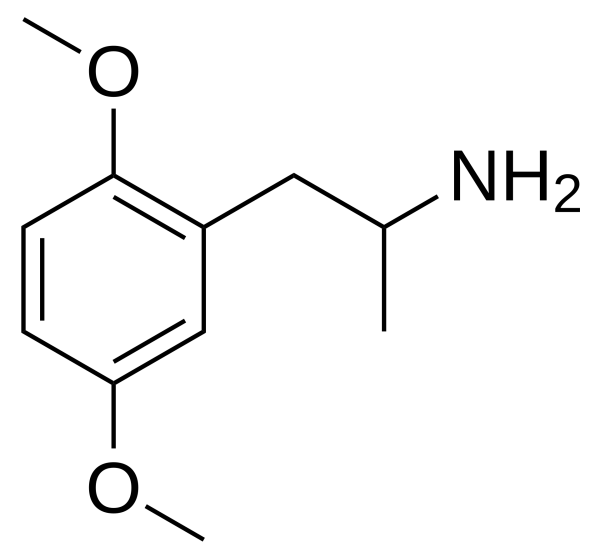
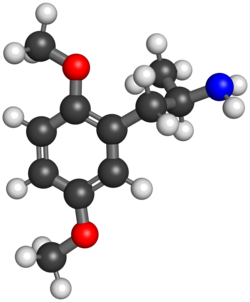
2,5-Dimethoxyamphetamine (2,5-DMA), also known as DOH, is a substituted amphetamine in the phenethylamine family. It forms the basic structure of the DOx series, a group of compounds with additional substituents on the aromatic ring. Unlike several of its better-known derivatives, 2,5-DMA is not generally described as a strongly psychedelic substance. The limited human accounts tend to describe physical stimulation and intoxication, with few or no clear sensory changes.
Chemistry
2,5-DMA has a phenethylamine backbone with a methyl group on the alpha carbon, which makes it an amphetamine. Its aromatic ring carries methoxy groups at the 2- and 5-positions, while the 4-position is unsubstituted. This arrangement makes it the parent structure of the DOx family.
The addition of a group at the 4-position produces compounds such as DOM and DOB, which have considerably stronger psychedelic activity than the parent compound. The corresponding phenethylamine without the alpha-methyl group is 2C-H. These compounds share a related framework, but their pharmacological properties are not interchangeable.
Pharmacology
Research on 2,5-DMA has focused mainly on its interaction with serotonin receptors. An early study in rats found that its effects on muscle-twitch activity were blocked by a serotonin receptor antagonist. The results suggested that the compound acted directly at serotonin receptors rather than by releasing serotonin in the way some other amphetamines do. (Tseng, 1978)
More recent work has found relatively weak activity compared with the 4-substituted DOx compounds. A 2025 study reported low-micromolar binding affinity at the serotonin receptors tested. In mice, 2,5-DMA produced a measurable head-twitch response, a behavioural measure used in research on psychedelic-like effects, but the response was weaker than that produced by several of its substituted analogues. These findings suggest some psychedelic-like activity in animals, but do not establish a strong psychedelic effect in humans. (Luethi et al., 2025)
Earlier receptor-binding research also examined the relationship between the structure of dimethoxyamphetamines and their activity at serotonin receptors. The results helped establish the importance of substitutions on the aromatic ring, particularly for the more active members of the DOx series. (Shannon et al., 1984)
Subjective effects
Reports of the human effects of 2,5-DMA are limited. The accounts collected in PsychonautWiki’s 2,5-DMA profile describe a substance that appears more stimulating than psychedelic, while the descriptions in Alexander Shulgin’s PiHKAL entry are similarly sparse and vary between reports.
Physical effects
Stimulation is one of the main effects described, although its intensity appears to vary. Shulgin’s own account focused on tremors and cardiovascular stimulation, without noticeable sensory effects. Other accounts describe a more pleasant intoxication and greater interest in the surroundings; another mentions distinctly amphetamine-like stimulation.
Other physical effects mentioned in the available descriptions include:
- Tremors and mild to moderate bodily discomfort.
- Cardiovascular effects, including increased heart rate and blood pressure.
- Muscle tension and occasional muscular incoordination.
- Vertigo or dizziness.
- Pupil dilation and increased perspiration.
- Changes in temperature regulation.
These effects come from a small number of historical accounts and have not been systematically studied in humans.
Visual effects
Pronounced visual effects are not a consistent feature of the reports. Shulgin described no sensory changes in his account, and other descriptions similarly mention intoxication without clear perceptual alterations. An earlier report did mention a temporary narrowing or “closing” of the visual field alongside vertigo. Colour enhancement is sometimes listed, but remains uncertain and is not a well-established effect.
Cognitive effects
Some accounts describe a mild sense of euphoria and greater interest in the immediate environment. Other effects listed in user reports include:
- Increased wakefulness and motivation.
- Greater appreciation of music and humour.
- Novelty enhancement or heightened interest in ordinary surroundings.
- Paranoia, which is reported as an unwanted psychological effect.
The available descriptions do not point to a consistent pattern of profound changes in thought or perception. The overall picture is closer to physical or stimulant-like intoxication than to a typical psychedelic experience.
Toxicity and interactions
The toxicity of 2,5-DMA has not been well characterised, and the available human reports are too limited to establish a reliable toxic range or long-term effects. A 2008 study of related 4-substituted DOx compounds examined their metabolism and CYP2D6 inhibition, but its findings do not establish the metabolic profile of 2,5-DMA itself.
Interaction information is similarly limited. User-oriented references flag combinations involving cannabis, stimulants, tramadol and lithium, and raise a particular concern about monoamine oxidase inhibitors (MAOIs). These warnings are not supported by a comprehensive set of clinical interaction studies specific to 2,5-DMA.
History and related compounds
The early chemistry of 2,5-dimethoxyphenylalkylamines is associated with work by Richard Baltzly and Johannes S. Buck in the late 1930s. The psychoactive properties of 2,5-DMA were discussed in later structure–activity research by Alexander Shulgin and colleagues, and Shulgin returned to the compound in his 1991 book PiHKAL. (Shulgin, Sargent and Naranjo, 1969)
2,5-DMA is mainly of interest as the parent structure of the DOx family. The addition of different groups at the 4-position gives rise to compounds such as DOM and DOB. A 1985 review by the World Health Organization’s Expert Committee on Drug Dependence also noted its use in the photographic industry and the absence of an established medical use.
Reviews
There are no reviews yet.