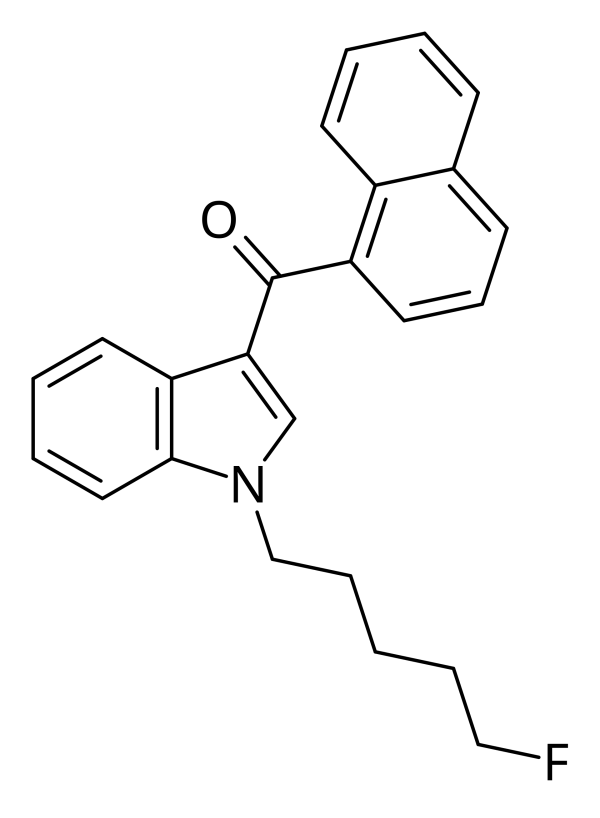
AM-2201 is a synthetic cannabinoid in the naphthoylindole family and the 5-fluoropentyl analogue of JWH-018. It is a potent full agonist at cannabinoid receptors and has been associated with serious non-fatal and fatal intoxications. The WHO reviewed the compound in 2014 and recommended international control after reports of harmful use, impaired driving and acute adverse reactions.
Chemistry and history
AM-2201 is [1-(5-fluoropentyl)-1H-indol-3-yl](naphthalen-1-yl)methanone. Its structure is closely related to JWH-018, but a fluorine atom is attached to the terminal carbon of the pentyl chain. This substitution can alter receptor affinity and metabolic pathways.
AM-2201 was reported in herbal smoking mixtures and later appeared in powders and other products. The UNODC database identifies it as a synthetic cannabinoid receptor agonist and records its inclusion in Schedule II of the 1971 Convention on Psychotropic Substances (UNODC substance record: AM-2201).
Pharmacology
AM-2201 is a full agonist at the CB1 receptor, with low-nanomolar binding affinity. The WHO review describes it as more potent in vitro than JWH-018. A comparative functional study found agonist activity at both CB1 and CB2 receptors and reported that terminal fluorination generally increased CB1 potency in the tested compounds, although this difference was not consistently reflected in the animal behavioural measures (Banister and colleagues, 2015).
Reported effects
The WHO review notes THC-like subjective effects in survey responses, alongside adverse reactions including restlessness, hallucinations and somnolence. Synthetic cannabinoid products can produce more severe and less predictable effects than cannabis, particularly when the active ingredient and its concentration are unknown.
Neurological and behavioural effects
Reported reactions include altered perception, agitation, hallucinations, anxiety and reduced alertness. Severe intoxication may involve seizures, loss of consciousness or marked behavioural disturbance.
Physical effects
Clinical and experimental reports describe changes in heart rate, body temperature and blood pressure. The WHO review also notes impaired driving and other situations in which psychomotor function was affected.
Clinical and forensic findings
The WHO critical review considered analytically confirmed non-fatal and fatal intoxications and concluded that AM-2201 posed a substantial public-health risk. It also noted that 22 Member States reported recreational or harmful use in the WHO survey (WHO critical review of AM-2201).
A systematic review of synthetic cannabinoid toxicity includes AM-2201 among the substances detected in clinical and post-mortem investigations, while emphasising that co-exposures and differences in analytical methods complicate the interpretation of individual cases (Systematic review of synthetic cannabinoid toxicity, 2023).
Toxicity and research limitations
AM-2201 has a more substantial forensic record than many newer synthetic cannabinoids. Even so, its long-term effects and dependence potential are not fully characterised. WHO noted that tolerance and withdrawal are plausible with repeated exposure to potent synthetic cannabinoid agonists, but called for more detailed compound-specific research.
Related compounds
AM-2201 is related to JWH-018, MAM-2201, EAM-2201 and 5F-PB-22. It is the terminally fluorinated analogue of JWH-018.

Reviews
There are no reviews yet.