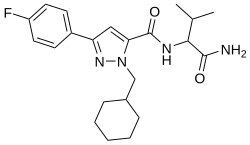
AB-CHFUPYCA is a synthetic cannabinoid identified in illegal herbal products in Japan in 2014. It belongs to a pyrazole-carboxamide group and is structurally distinct from the more familiar indazole-carboxamide cannabinoids such as AB-CHMINACA. The original analytical report established its chemical structure, but noted that pharmacological data were not available at the time.
Chemistry and identification
The full chemical name is N-(1-amino-3-methyl-1-oxobutan-2-yl)-1-(cyclohexylmethyl)-3-(4-fluorophenyl)-1H-pyrazole-5-carboxamide. Its structure contains a fluorophenyl-substituted pyrazole ring, a cyclohexylmethyl group and a valinamide-derived side chain. The molecular formula reported in the original study was C22H29FN4O2.
The compound was identified in seized herbal products using GC-MS, LC-MS, high-resolution mass spectrometry and nuclear magnetic resonance. The researchers named it AB-CHFUPYCA after confirming that it contained a pyrazole core rather than the indazole core found in AB-CHMINACA (Uchiyama and colleagues, 2015).
Pharmacology
The original identification paper stated that pharmacological data for AB-CHFUPYCA were not available. Its classification as a synthetic cannabinoid reflects its chemical family and context of detection, but a specific CB1 or CB2 receptor potency should not be inferred from its resemblance to other compounds.
Later research on related pyrazole-carboxamides has examined positional isomers and their analytical differences. Such work is important because the position of the carboxamide group on the pyrazole ring can change the identity of the substance. Results for a regioisomer should not automatically be attributed to AB-CHFUPYCA itself (Analytical characterisation of novel synthetic cannabinoids, 2016).
Reported effects
Human information about AB-CHFUPYCA is too limited to establish a characteristic experience reliably. The original paper concerned chemical identification, with no controlled pharmacological or clinical observations.
Adverse effects documented for other synthetic cannabinoid receptor agonists include agitation, confusion, seizures and cardiovascular complications. These are class-level concerns, not confirmed effects specific to AB-CHFUPYCA.
Toxicity and research limitations
No well-characterised clinical case series, human metabolism study or controlled toxicity assessment specific to AB-CHFUPYCA was identified in the available literature. Its receptor activity, acute toxic range, metabolism, dependence potential and long-term effects remain uncertain.
Its identification in seized herbal products confirms that the compound appeared in the illicit market, but does not establish its prevalence or the extent of human exposure. Reliable toxicological assessment requires a confirmed reference standard and clear distinction from related pyrazole regioisomers.
Related compounds
AB-CHFUPYCA is related by broad chemical design to 5F-AB-FUPPYCA and AB-CHMINACA. It differs from AB-CHMINACA by its pyrazole rather than indazole core and by its fluorophenyl substituent.
Reviews
There are no reviews yet.