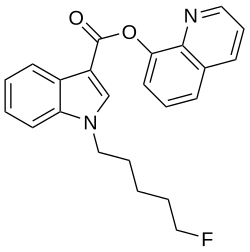
5F-PB-22, also known as 5F-QUPIC, is a synthetic cannabinoid in the quinolinyl ester indole family. It is a fluorinated analogue of PB-22 and acts as a potent cannabinoid receptor agonist. The compound was identified in drug materials in 2013 and later appeared in traffic-related and forensic investigations. Published research documents its metabolism, high CB1 activity and involvement in several fatal cases.
Chemistry and identification
5F-PB-22 is quinolin-8-yl 1-(5-fluoropentyl)-1H-indole-3-carboxylate. Its structure contains an indole core, a 5-fluoropentyl chain and a quinolin-8-yl ester group. This ester linkage distinguishes it from the indazole-carboxamide compounds that dominate many later generations of synthetic cannabinoids.
The compound is also known as 5F-QUPIC. Forensic laboratories have used mass spectrometry and reference standards to distinguish it from PB-22 and related quinolinyl ester cannabinoids.
Pharmacology
5F-PB-22 is a potent agonist at the CB1 receptor. In a functional assay using recombinant human CB1 receptors, it was reported to be approximately 100 times more potent than WIN-55,212-2 and 36 times more potent than JWH-018. These are assay-specific comparisons and should not be interpreted as direct estimates of human effects (Forensic Toxicology study of super-strength synthetic cannabinoids, 2017).
Metabolism
Human hepatocyte experiments found that ester hydrolysis is the predominant metabolic pathway for 5F-PB-22. The process produces a range of fluoropentylindole-3-carboxylic acid metabolites, followed by oxidation and, in some cases, glucuronidation. Twenty-two metabolites were identified in the study, providing useful markers for toxicological analysis (Moran and colleagues, 2014).
Because the parent compound is rapidly transformed, detection of metabolites can be important when investigating suspected exposure. The metabolic profile also illustrates why routine screening methods may fail to identify newer synthetic cannabinoids.
Reported effects and clinical findings
Clinical reports of synthetic cannabinoid exposure include altered consciousness, agitation, confusion, seizures and cardiovascular disturbances. In Japan, 5F-PB-22 was detected in a series of traffic-related incidents involving potent synthetic cannabinoids. Catalepsy and muscle rigidity were noted in several cases, with impairment contributing to serious road incidents (Forensic Toxicology, 2017).
Fatal cases and toxicology
Four post-mortem cases with quantitative detection of 5F-PB-22 were reported in 2014. Concentrations in the available post-mortem blood and antemortem serum samples ranged from 1.1 to 1.5 ng/mL. The authors described sudden deaths and one case that deteriorated rapidly in hospital, while cautioning that concentration alone cannot establish causation (Hess and colleagues, 2014).
A separate German forensic report included a fatal case involving 5F-PB-22 together with 5F-AKB48 and alcohol. The authors attributed the death to combined exposure rather than to 5F-PB-22 in isolation (Angerer and colleagues, 2017).
Research limitations
The evidence establishes potent CB1 activity and the possibility of severe or fatal intoxication. However, post-mortem redistribution, tolerance, co-exposures and differences in sampling time complicate the interpretation of blood concentrations. The long-term effects of repeated exposure are not well characterised.
Related compounds
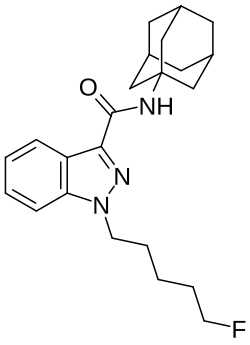
5F-PB-22 is related to PB-22, 5F-MDMB-2201 and other fluorinated indole cannabinoids. Its quinolinyl ester structure distinguishes it from the carboxamide-based compounds.

Reviews
There are no reviews yet.