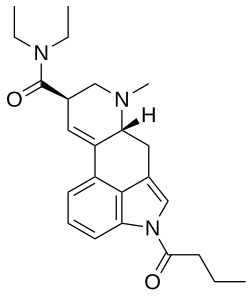
1B-LSD, or 1-butanoyl-lysergic acid diethylamide, is an N1-acyl derivative of LSD. A butanoyl group is attached to the indole nitrogen of the lysergamide structure. The compound appeared on the new psychoactive substance market before it had been described in detail in the scientific literature. Laboratory studies show that it can be converted to LSD and produces LSD-like behaviour in mice, but controlled human pharmacology remains limited.
Chemistry and identification
1B-LSD retains the ergoline skeleton and N,N-diethylamide group of LSD. Its distinguishing feature is a four-carbon butanoyl group attached at the N1 position. It belongs to the same broad group of N1-acyl lysergamides as 1P-LSD and 1cP-LSD, although the size and shape of the acyl substituent differ.
The compound was identified in paper products in Japan using chromatographic and spectrometric methods, including GC-MS, LC-MS, high-resolution MS and NMR. The study also noted that N1-acyl lysergamides can lose their acyl group during GC-MS analysis, potentially producing LSD as an analytical artefact if sample preparation is not carefully controlled (Tanaka and colleagues, 2020).
Pharmacology and conversion to LSD
Research suggests that 1B-LSD’s effects may depend substantially on its conversion to LSD. In a study of N1-acyl lysergamides, 1B-LSD showed weak activity in some serotonin-receptor assays compared with LSD. In mice, however, it produced a dose-related head-twitch response, a behavioural marker associated with 5-HT2A receptor activation. Its molar potency in this test was about 14% of LSD’s (Brandt and colleagues, 2019).
The same research group found that 1B-LSD could be deacylated by enzymes in human serum and liver preparations. A broader study of N1-acyl derivatives concluded that conversion to LSD is a plausible explanation for their LSD-like behavioural effects, although the exact contribution of the parent compound may vary between analogues (Halberstadt and colleagues, 2020).
Subjective effects and human evidence
The subjective effects of 1B-LSD itself have not been established in a substantial controlled human study. Reports that compare it with LSD are difficult to interpret because the compound may be converted to LSD after exposure, and the identity or composition of unregulated products is not always independently confirmed.
1B-LSD has shown LSD-like activity in animal models, but a detailed account of its effects in humans remains unconfirmed.
Metabolism and analytical limitations
Deacylation is an important pathway for this group. The parent compound may be difficult to distinguish from LSD if a sample is exposed to conditions that promote hydrolysis during analysis. This is particularly relevant to GC-MS, where thermal or solvent-related degradation can complicate identification.
Human pharmacokinetic data for 1B-LSD remain insufficient to define its absorption, elimination or metabolite profile in detail. There is also no reliable clinical concentration-toxicity relationship.
What remains unknown
The available research establishes its chemical identity, LSD-like activity in mice and potential conversion to LSD. It does not establish a full human safety profile, dependence liability or long-term effects. Evidence from LSD and other acylated lysergamides provides context, but cannot answer those questions for 1B-LSD itself.
Related lysergamides
1B-LSD is related to 1P-LSD, 1cP-LSD, 1D-LSD and 1Fe-LSD. These compounds are all modified at N1, but differ in their substituents and in how much direct research is available.
1B-LSD Products
Scientific Data
Structured reference fields associated with this compound.
Identity and Structure
Chemical Identifiers
Clinical Data
Legal Status
BR: Class F2 (Prohibited psychotropics)
CA: Unscheduled
DE: NpSG (Industrial and scientific use only)
UK: Under Psychoactive Substances Act
US: Unscheduled (may be covered by the Federal Analogue Act if sold for human consumption)
UN: Unscheduled