1P-LSD, or 1-propionyl-lysergic acid diethylamide, is an N1-acyl derivative of LSD. It appeared on the research-chemical market in the mid-2010s and became one of the best-studied newer lysergamides. Evidence from animal experiments, serum studies and a small human pharmacokinetic report indicates that 1P-LSD can be converted to LSD. Human data remain too limited to establish its clinical profile fully.
Chemistry and early identification
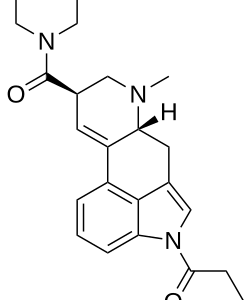
1P-LSD retains the ergoline core and N,N-diethylamide group of LSD. Its principal structural change is a propionyl group attached to the indole nitrogen at N1. It is closely related to 1B-LSD and 1cP-LSD, which carry butanoyl and cyclopropanoyl groups at the same position.
The compound was first described analytically in 2016 after appearing as a research chemical in blotter and powder form. The original paper compared its structure with LSD and used animal behaviour to investigate whether it produced a serotonergic psychedelic signal (Brandt and colleagues, 2016).
Pharmacology and conversion to LSD
In mice, 1P-LSD produced a dose-related head-twitch response, which is commonly used as a behavioural marker of 5-HT2A receptor activation. Its potency in that assay was lower than LSD’s. Later work found that N1-acyl substitution reduced direct receptor activity in some in-vitro assays, while 1P-LSD was rapidly deacylated to LSD in rat studies and in human serum or liver preparations (Halberstadt and colleagues, 2020).
Together, these findings support the view that at least part of 1P-LSD’s LSD-like activity may arise after conversion to LSD. They do not show that every effect is caused exclusively by the metabolite.
Human pharmacokinetics
A small human report examined oral and intravenous administration in two volunteers. Following oral exposure, LSD rather than unchanged 1P-LSD was detected in serum and urine. The reported terminal elimination half-life for LSD was approximately 6.4 hours. Because the study involved only two people, it provides preliminary evidence rather than a reliable population-level pharmacokinetic profile (Grumann and colleagues, 2020).
Subjective effects and limitations
The human report included psychometric assessments, but its very small sample cannot establish the full range, frequency or duration of subjective effects. Many online descriptions compare 1P-LSD with LSD; the metabolic findings help explain the comparison, but cannot replace larger controlled studies.
There is no well-established concentration-toxicity relationship or long-term safety profile specific to 1P-LSD. Analytical studies also show that N1-acyl lysergamides can be deacylated during some sample-preparation and GC-MS procedures, which may affect forensic identification.
Related lysergamides
1P-LSD is related to 1B-LSD, 1cP-LSD, 1D-LSD, 1Fe-LSD and 1S-LSD. These compounds share N1 modification, but the nature of the substituent and the strength of the available evidence differ.
1P-LSD Products
Scientific Data
Structured reference fields associated with this compound.
Identity and Structure
Chemical Identifiers
Clinical Data
Pharmacokinetics
Legal Status
BR: Class F2 (Prohibited psychotropics)
CA: Unscheduled.
DE: NpSG (Industrial and scientific use only)
UK: Under Psychoactive Substances Act
US: Unscheduled (may be considered illegal if sold for human consumption as an analog of LSD under the federal analogue act)
UN: Unscheduled
In general Unscheduled, unless that was sold for human consumption, could be sold for medical and research purposes.