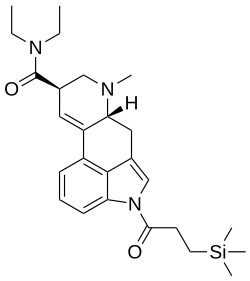
1S-LSD is a silicon-containing lysergamide, identified chemically as 1-[3-(trimethylsilyl)propanoyl]-LSD. It differs from more familiar N1-acyl derivatives by carrying a trimethylsilyl group on the propanoyl side chain. The compound was identified in paper products sold online, and a 2026 study described its metabolism in human liver microsomes. Direct human pharmacology and clinical effects remain uncharacterised.
Chemistry and identification
1S-LSD retains the LSD ergoline structure and N,N-diethylamide group. At the N1 position, it carries a 3-(trimethylsilyl)propanoyl substituent. The silicon-containing group makes it chemically distinct from 1P-LSD, 1B-LSD and 1cP-LSD, even though all are modified at the same nitrogen position.
In 2025, Japanese researchers identified 1S-LSD in paper-sheet products obtained from internet sources. The same study identified 1T-AL-LAD in material marketed under the name 1D-AL-LAD, highlighting the importance of confirming the actual composition of blotter products rather than relying on printed labels (Tanaka and colleagues, 2025).
Metabolism
A 2026 study incubated 1S-LSD with human liver microsomes and identified 62 metabolites. LSD appeared early in the metabolic process, while many of the major products involved hydroxylation of the silylpropanoyl group. The researchers also identified several relatively abundant metabolites that retained the silicon-containing substituent, including N-deethylated, hydroxylated and silanolised products (Azuma and colleagues, 2026).
The work identifies potential forensic markers, but the in-vitro liver experiments do not establish the complete metabolic pathway in living humans.
Pharmacology and reported effects
No controlled human study has established the receptor activity, subjective effects or clinical duration of 1S-LSD. The early formation of LSD in microsomes suggests that deacylation may be relevant, but it is not sufficient to conclude how much LSD is formed in people or what proportion of any effects would be attributable to the metabolite.
Descriptions of LSD or other N1-acyl lysergamides offer comparisons, but do not establish the effects of 1S-LSD.
Toxicology and research limitations
The available literature establishes that 1S-LSD has appeared in paper products and that it undergoes extensive metabolism in human liver microsomes. It does not establish a human toxic range, dependence potential or long-term safety profile. The presence of silicon in the side chain also means that forensic screening may need to target characteristic metabolites rather than relying only on methods designed for conventional LSD analogues.
Related lysergamides
1S-LSD is related to 1P-LSD, 1B-LSD, 1cP-LSD, 1D-LSD and 1Fe-LSD. Its distinguishing feature is the trimethylsilyl-containing acyl group.
1S-LSD Products
Scientific Data
Structured reference fields associated with this compound.