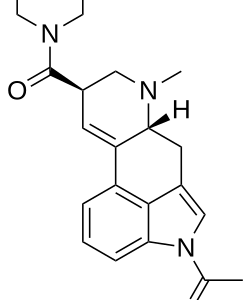
ALD-52, also known as 1-acetyl-LSD or 1A-LSD, is an N1-acetyl derivative of lysergic acid diethylamide. It differs from LSD by an acetyl group attached to the indole nitrogen. The compound was first synthesised in the 1950s and was tested in humans in early clinical research. Modern laboratory work indicates that it is rapidly deacetylated to LSD, which likely accounts for much of its LSD-like activity.
Chemistry and early research
ALD-52 retains the ergoline skeleton and N,N-diethylamide group of LSD. Its acetyl substituent at N1 makes it the simplest member of the N1-acyl lysergamide group. It is structurally related to 1P-LSD, 1B-LSD and 1cP-LSD, which carry larger or differently shaped acyl groups.
ALD-52 was synthesised by Albert Hofmann and colleagues in the 1950s. Human experiments published between 1957 and 1960 reported LSD-like effects and broadly similar time courses. One early study described it as slightly less potent than LSD, while another considered the two compounds approximately equipotent. The historical studies were small and predated modern clinical-trial standards (Halberstadt and colleagues, 2019/2020).
Receptor pharmacology
In modern receptor assays, N1-acetyl substitution reduced ALD-52’s affinity for several monoamine receptors, including 5-HT2A, compared with LSD. It also showed weak efficacy or antagonist-like behaviour in some calcium-mobilisation assays. Despite this, ALD-52 produced a dose-related head-twitch response in mice, a behavioural marker associated with 5-HT2A activation (Pharmacological and biotransformation studies of N1-acyl LSD derivatives, 2019).
Conversion to LSD
The same study found high levels of LSD in rat plasma after administration of ALD-52. Experiments also showed that enzymes in human serum and liver preparations could remove the acetyl group. These findings support the conclusion that ALD-52 acts, at least in part, as a prodrug for LSD. The intact compound may have its own receptor interactions, but conversion to LSD appears to be central to its behavioural effects.
Human effects and evidence limits
The historical human studies describe effects similar to LSD, but they were conducted decades ago with limited methodological detail. Modern controlled research has focused mainly on receptor pharmacology and biotransformation in animals, rather than new human clinical trials. There is no contemporary human pharmacokinetic study establishing the proportion of ALD-52 converted to LSD or the timing of that conversion.
Toxicology and research limitations
ALD-52 has no well-characterised modern concentration-toxicity relationship, and controlled studies of dependence or long-term effects are lacking. Its historical human use and modern prodrug evidence provide a stronger basis for describing its pharmacology than exists for many newer lysergamides, but do not fully establish its safety.
Related lysergamides
ALD-52 is related to 1P-LSD, 1B-LSD, 1cP-LSD, 1D-LSD and 1V-LSD. All carry a substituent at the N1 position, but the size and type of that group differ.