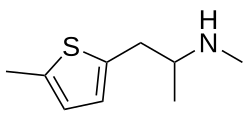
5-Methylmethiopropamine (5-MMPA), also known as mephedrene, is a synthetic stimulant related to methiopropamine. It contains a methyl group on the thiophene ring and is an arylalkylamine rather than a cathinone. The compound was first seized in Germany in 2020. Recent laboratory work has begun to describe its activity at monoamine transporters, while a forensic report has associated it with a fatal intoxication.
Chemistry
5-MMPA is a thiophene-based analogue of methiopropamine. Its structure contains a methyl-substituted thiophene ring attached to an alpha-methylated amine chain. Unlike synthetic cathinones, it does not contain a carbonyl group at the beta position of the side chain. It is therefore more accurately classified as a substituted amphetamine-like arylalkylamine.
Pharmacology
A 2026 in-vitro study measured the effects of 5-MMPA at the dopamine, norepinephrine and serotonin transporters. It inhibited all three, with the strongest activity at the norepinephrine transporter (NET), followed by the dopamine transporter (DAT). Its activity at the serotonin transporter (SERT) was considerably weaker. The study also found only limited activation of the 5-HT2A receptor at the highest concentration tested (Stalberga and colleagues, 2026).
The results place 5-MMPA among stimulants with a pronounced noradrenergic component. The measurements were made in vitro, so they do not establish the intensity or character of its effects in humans.
Reported effects
A characteristic 5-MMPA experience has not been established from reliable human accounts. Its transporter activity is consistent with stimulant effects, but detailed claims about euphoria, concentration, sociability or duration would go beyond the available evidence.
Effects associated with related stimulants may include increased wakefulness, restlessness and cardiovascular stimulation. These are class-based expectations, not a confirmed list of effects specific to 5-MMPA.
Metabolism and forensic findings
A 2022 conference report described an investigation of 5-MMPA metabolism after the compound was detected in a fatal intoxication. The researchers examined human liver microsomes and a post-mortem urine sample to identify phase I metabolites. The abstract confirms that human metabolism was investigated, but does not provide enough detail to establish a complete metabolic pathway or the compound’s independent contribution to the death (Schwelm and colleagues, 2022).
5-MMPA has also been detected in routine toxicology testing. A 2024 analytical study included it among the new psychoactive substances identified in biological samples, demonstrating that it has entered real-world forensic casework (Barone and colleagues, 2024).
Toxicity and research limitations
There are no controlled human studies establishing the acute toxic range, dependence potential or long-term effects of 5-MMPA. The recent transporter study adds pharmacological evidence, but does not determine the clinical consequences of repeated exposure. The fatal post-mortem investigation also cannot establish a precise concentration-response relationship.
Related compounds
5-MMPA is related to Methiopropamine and other thiophene-based amphetamine analogues. Despite its inclusion in some broad lists of emerging stimulants, it is not a β-keto cathinone.

Reviews
There are no reviews yet.