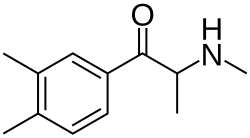
3,4-Dimethylmethcathinone (3,4-DMMC) is a synthetic cathinone stimulant with methyl groups at the 3- and 4-positions of the phenyl ring. It has appeared on the recreational drug market as an alternative to other controlled cathinones. Its pharmacology has not been studied in depth, but forensic literature includes analytically confirmed fatal poisonings in which 3,4-DMMC was considered the principal toxic substance.
Chemistry
3,4-DMMC belongs to the ring-substituted methcathinones. Its structure contains the β-keto amphetamine framework, an N-methyl group and two methyl substituents on the aromatic ring. It is related to 3-MMC and 4-MMC, but has an additional methyl group on the phenyl ring.
Pharmacology
There is limited direct research on the pharmacology of 3,4-DMMC. Its stimulant classification follows from its cathinone structure, but the precise balance of dopamine, norepinephrine and serotonin activity has not been adequately characterised.
Most of the available compound-specific research is analytical and forensic rather than pharmacodynamic. Studies have identified 3,4-DMMC and its metabolites in blood and urine, without fully explaining how it acts in the central nervous system.
Reported effects
There is no robust collection of controlled human observations from which to define the subjective effects of 3,4-DMMC. It is generally described as a stimulant because of its chemical class, but detailed claims about euphoria, empathy, focus or duration are not supported by sufficient compound-specific evidence.
Clinical and forensic findings
A 2014 forensic study reported a fatal case in which 3,4-DMMC was quantified in blood and urine. The investigators measured 27 mg/L in blood and 7.6 mg/L in urine, and identified metabolites including 3,4-dimethylcathinone and β-keto-reduced products (Usui and colleagues, 2014).
A separate Polish autopsy report described the death of a 31-year-old man in which 3,4-DMMC was detected at 3.31 μg/mL in whole blood. The authors judged poisoning by 3,4-DMMC to be the cause of death; their screening did not identify other drugs or poisons that could explain the outcome (Sykutera and Bloch-Bogusławska, 2015).
3,4-DMMC has also appeared in broader forensic datasets of synthetic cathinone intoxications. Such datasets include fatal and non-fatal cases, but they often involve multiple substances and cannot be used to establish a single concentration threshold for toxicity (Toxicological analysis of synthetic cathinone intoxications, 2022).
Toxicity and research limitations
The fatal cases demonstrate that 3,4-DMMC exposure can be associated with lethal poisoning. They do not establish a general toxic range or show how risk varies with exposure circumstances. Controlled studies of its acute effects, metabolism in living people, dependence potential and long-term toxicity are lacking.
Its structural similarity to 3-MMC and 4-MMC should not be taken as evidence that the compounds have interchangeable effects. The additional ring substitution may alter pharmacological activity, and the available evidence is too limited to quantify those differences.
Related compounds
3,4-DMMC is related to 3-MMC, 4-MMC and other ring-substituted methcathinones. It differs from 3-MMC by carrying an additional methyl group at the 4-position of the phenyl ring.

Reviews
There are no reviews yet.