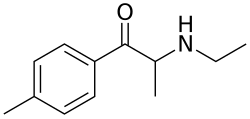
4-Methylethcathinone (4-MEC) is a synthetic cathinone stimulant related to mephedrone. It has a methyl group at the para position of the phenyl ring and an ethyl group attached to the amino nitrogen. 4-MEC appeared on the recreational drug market in the early 2010s and was later placed under international control. Laboratory studies show a mixed transporter profile, while forensic reports include fatal intoxications.
Chemistry
4-MEC is a β-keto amphetamine, with the carbonyl group on the side chain that defines the cathinone family. Its structure is closely related to mephedrone (4-MMC), but the nitrogen carries an ethyl group rather than a methyl group. It has a chiral centre and therefore exists as two enantiomers, (R)-4-MEC and (S)-4-MEC.
Pharmacology
In vitro experiments found that 4-MEC has an unusual combination of transporter actions. It acts as a substrate at the serotonin transporter (SERT), promoting serotonin release, while blocking the dopamine transporter (DAT). In rat brain studies, it produced a large increase in extracellular serotonin but a smaller increase in dopamine. This differs from the profile of mephedrone and helps explain why structural similarity does not necessarily mean identical effects (Saha and colleagues, 2015).
A broader study of designer cathinones also found that 4-MEC inhibited monoamine uptake and released serotonin. The authors reported substantial differences between cathinones, even when the compounds shared closely related structures (Simmler and colleagues, 2014).
Reported effects
The available PsychonautWiki entry for 4-MEC is a discussion page rather than a fully developed article. It compiles anecdotal reports describing a mixture of stimulant and entactogenic effects. These accounts are not controlled observations and do not establish a consistent response.
Physical effects
Reports describe stimulation, increased energy and a tingling bodily sensation. Jaw tension, involuntary shaking and reduced fine motor control are also mentioned. Other reported effects include sweating, increased blood pressure, nausea, vomiting, heart palpitations and headaches. Some users have described visual disturbance, although this is not a defining feature of the available profile.
Cognitive and emotional effects
Euphoria, faster thinking, increased motivation and disinhibition appear in user accounts. Empathy and sociability are also reported, but are often described as less pronounced than with MDMA. Adverse effects reported by users include anxiety, irritability and compulsive redosing.
Clinical and forensic findings
4-MEC has been detected in fatal and non-fatal intoxications. A case report published in 2021 described a man found dead with a high concentration of 4-MEC in post-mortem samples; the authors attributed the death to 4-MEC intoxication. The report also reviewed its distribution in biological tissues and the problems of post-mortem redistribution (Fatal 4-MEC intoxication, 2020).
Two earlier fatalities were also reported. One involved collapse and seizures after 4-MEC use, with the death attributed to 4-MEC toxicity. The second involved several substances and was attributed primarily to asphyxiation, illustrating the difficulty of interpreting mixed-drug cases (Maskell and colleagues, 2016).
Toxicity and research limitations
Animal studies show stimulant-like behavioural effects and evidence consistent with abuse potential. However, controlled studies of dependence in humans have not been reported. The fatal cases establish that serious poisoning can occur, but they do not define a reliable toxic range or explain the risk associated with every exposure.
4-MEC was placed in Schedule II of the 1971 Convention on Psychotropic Substances following a later WHO review. The WHO assessment noted its monoamine-transporter activity, reports of adverse effects and evidence of stimulant-like effects in animal studies (WHO Expert Committee on Drug Dependence: 4-MEC).
Related compounds
4-MEC is related to 3-MMC, 4-MMC (mephedrone) and 3,4-DMMC. It is the N-ethyl analogue of mephedrone, but its transporter profile is not identical.

Reviews
There are no reviews yet.