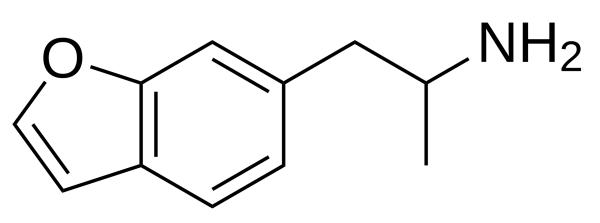
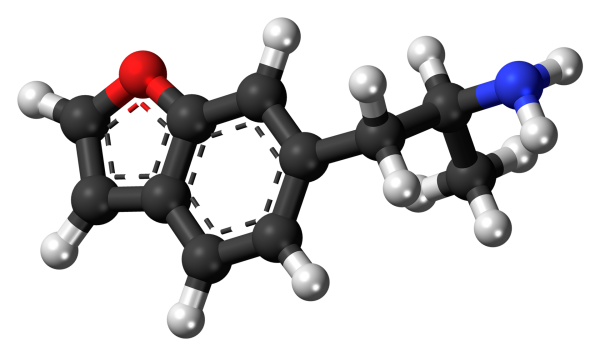
6-(2-Aminopropyl)benzofuran (6-APB), commonly known as Benzofury, is a synthetic entactogen and stimulant in the benzofuran family. It is structurally related to MDA and MDMA and is a positional isomer of 5-APB. 6-APB has been sold as a recreational research chemical since the early 2010s. Laboratory studies show that it releases dopamine, norepinephrine and serotonin, while clinical reports describe acute psychosis and other serious adverse effects.
Chemistry and history
6-APB contains an aminopropyl side chain attached to the 6-position of the benzofuran ring. Its structure is closely related to 5-APB, with the only positional difference being the attachment point on the aromatic system. It is also related to MDA, but the methylenedioxy ring of MDA is replaced by a benzofuran ring.
6-APB was first synthesised in 1993 during research into possible alternatives to MDMA. It did not become widely available until the early 2010s, when it was sold online and in head shops under the name Benzofury. The UK placed 6-APB and related benzofurans under control in 2014.
Pharmacology
6-APB is a substrate-type releasing agent at dopamine, norepinephrine and serotonin transporters. In vitro studies found strong activity across all three systems, with a profile broadly similar to MDA and MDMA. It also interacts with serotonin receptors, including 5-HT2A and 5-HT2B (Rickli and colleagues, 2015).
In rat studies, 6-APB increased extracellular dopamine and serotonin and produced sustained locomotor activation. It was more potent than MDA in several transporter-release measures, although the findings are from experimental models and do not establish human potency (Brandt and colleagues, 2020).
Subjective effects
The PsychonautWiki profile of 6-APB includes frequent comparisons with the entactogenic effects of MDA. Users report euphoria, reduced anxiety and disinhibition, alongside a mixture of stimulation and physical relaxation.
Physical effects
Some users describe 6-APB as less energetic than MDMA or MDA, with a more pronounced relaxing or heavy bodily sensation. Physical euphoria and tactile enhancement may occur. Other reported effects include increased heart rate, sweating, dehydration, appetite suppression and muscle tension.
Jaw clenching, raised body temperature and vasoconstriction are also reported. The balance between stimulation and sedation differs between accounts.
Emotional and cognitive effects
Empathy, affection, sociability and emotional openness are commonly described. Users also report euphoria, increased appreciation of music, disinhibition and changes in the perception of time. Anxiety may be reduced, although some accounts describe restlessness, confusion or difficulty sleeping after the main effects fade.
Visual and sensory effects
Reported changes include brighter colours, enhanced visual detail and altered perception of movement. Auditory and tactile sensitivity may also increase. These effects are generally described as secondary to the emotional and physical aspects of the experience.
Clinical toxicity
A case report described acute psychosis and agitation after a person used 6-APB with cannabis. Toxicological analysis confirmed 6-APB in urine, although metabolites of a synthetic cannabinoid were also detected, making it difficult to attribute every symptom to one substance (Dargan and colleagues, 2013).
Other clinical reports involving benzofurans describe cardiovascular and neurological complications consistent with a stimulant toxidrome. In vitro work has also identified 5-HT2B receptor agonism among several benzofurans, which has raised questions about possible cardiovascular effects.
Toxicity and research limitations
The toxicology of 6-APB in humans is still incompletely understood. A short history of recreational use and a relatively small number of clinical cases make it difficult to estimate the frequency of serious adverse events. Animal studies show sustained monoamine release and behavioural activation, while clinical reports demonstrate that acute psychiatric complications can occur.
Repeated exposure may carry cardiovascular and neurological risks, but the long-term effects have not been established in controlled human studies.
Related compounds
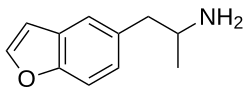
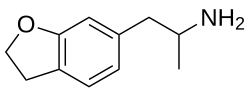
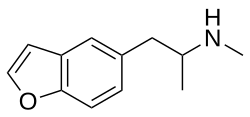
6-APB is related to 5-APB, 5-MAPB and 6-APDB. It is the 6-position isomer of 5-APB and the unsaturated analogue of 6-APDB.
Reviews
There are no reviews yet.