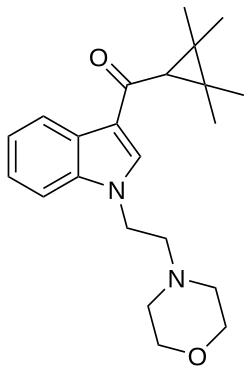
A-796,260, also known as LTI-258, is a synthetic cannabinoid research compound developed as a selective agonist of the cannabinoid CB2 receptor. Unlike many substances sold as recreational synthetic cannabinoids, it was investigated primarily for its potential analgesic properties in preclinical pain models. It shows strong CB2 activity and selectivity over CB1, but there is no established human therapeutic use.
Chemistry and research background
A-796,260 is an indole-derived cannabinoid with a tetramethylcyclopropyl ketone substituent. It belongs to a group of experimental ligands developed to investigate the role of CB2 receptors in pain and inflammation. Its research history is distinct from that of many newer synthetic cannabinoid receptor agonists detected in herbal smoking mixtures.
Pharmacology
In receptor-binding and functional assays, A-796,260 showed high affinity and agonist efficacy at human and rat CB2 receptors, with selectivity over the CB1 subtype. The original study also examined its behavioural effects in inflammatory, post-operative, neuropathic and osteoarthritis pain models in rodents. Its analgesic effects were consistent with CB2 receptor activation (In vitro and in vivo characterization of A-796,260, 2007).
CB2 receptors are expressed prominently in immune and peripheral tissues, although their distribution and role in the nervous system are more complex than once assumed. Selectivity for CB2 distinguishes A-796,260 from strongly psychoactive CB1 agonists.
Effects in experimental models
The published work describes analgesic activity in rodent models of inflammatory and neuropathic pain. These findings were generated in controlled laboratory settings and do not demonstrate that A-796,260 is an effective or safe pain treatment in humans.
Human accounts are too scarce to support a description of recreational or subjective effects. The cannabis-like effects commonly associated with potent CB1 agonists cannot simply be attributed to it.
Toxicity and research limitations
No established clinical safety profile, human pharmacokinetic study or therapeutic trial was identified in the available literature. Its acute toxicity, metabolism, dependence potential and long-term effects in people remain unknown.
A-796,260 is best understood as a preclinical CB2-selective research ligand. Its presence in synthetic cannabinoid monitoring lists does not mean it has the same pharmacology or recreational-use history as CB1-active compounds.
Related compounds
A-796,260 is related to other experimental indole cannabinoids, including A-834,735. The two compounds differ importantly in receptor selectivity: A-796,260 is CB2-selective, whereas A-834,735 activates both CB1 and CB2 receptors in animal assays.

Reviews
There are no reviews yet.