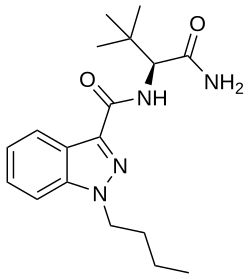
ADB-BUTINACA, also known as ADB-BINACA, is a synthetic cannabinoid in the indazole-3-carboxamide family. It has been detected in herbal material, powders and paper products and is associated with severe intoxications, including deaths. WHO describes it as a potent full agonist at CB1 and CB2 receptors, although controlled studies of its effects in humans remain limited.
Chemistry and identification
ADB-BUTINACA is N-[1-(aminocarbonyl)-2,2-dimethylpropyl]-1-butyl-1H-indazole-3-carboxamide. It contains an indazole core, a butyl group on the ring nitrogen and a tert-leucine-derived carboxamide side chain. It is structurally related to ADB-PINACA and 5F-ADB, but differs in the length and substitution of the N-alkyl chain.
The substance was first identified in Europe in 2019 and later appeared in drug-monitoring reports from several regions. The WHO reviewed it in 2022 and recommended international control because of its potency and reported harms (WHO critical review of ADB-BUTINACA).
Pharmacology
ADB-BUTINACA binds to CB1 and CB2 receptors with high affinity and acts as a potent full agonist at both. WHO notes that its mechanism resembles that of other potent synthetic cannabinoid receptor agonists. There are no controlled human studies that define its subjective effects or dependence potential, but the CB1 activity supports concern about abuse and dependence (WHO Expert Committee on Drug Dependence).
Reported effects
Online self-reports summarised by WHO mention euphoria, appetite stimulation, sedation and paranoia. Clinical reports are more concerning and include altered consciousness, loss of consciousness and other severe adverse reactions. These descriptions are not based on controlled human trials.
Neurological and systemic effects
Reports from emergency departments include impaired consciousness and severe intoxication. As with other potent synthetic cannabinoids, seizures, agitation and cardiovascular disturbances are relevant clinical concerns, although not every symptom has been confirmed in a controlled ADB-BUTINACA study.
Clinical and forensic findings
WHO records multiple deaths and emergency presentations associated with ADB-BUTINACA. In some cases, other substances were also present; in others, ADB-BUTINACA was the only identified drug of concern. A 2026 forensic study examined three fatal mixed-intoxication cases and measured the compound across blood, urine, bile, vitreous humour and multiple tissues. The authors assigned toxicological significance scores suggesting a possible to likely contribution to death, while noting the presence of other drugs in all three cases (ADB-BUTINACA in three post-mortem cases, 2026).
Metabolism and research limitations
Human liver microsome studies have identified multiple ADB-BUTINACA metabolites and proposed urinary biomarkers for forensic detection. A 2021 study examined phase I metabolism and enzyme involvement, while the 2026 post-mortem series compared metabolites in authentic samples with results from in-vitro systems (Urinary metabolite biomarkers for ADB-BUTINACA, 2021).
The clinical findings raise serious public-health concerns, but mixed exposures and the limited number of analytically confirmed cases make it difficult to establish a concentration threshold or assess long-term risks.
Related compounds
ADB-BUTINACA is related to ADB-PINACA, 5F-ADB and AB-CHMINACA. These compounds share an indazole-carboxamide framework but differ in their N-alkyl substituents and amino-acid-derived side chains.

Reviews
There are no reviews yet.