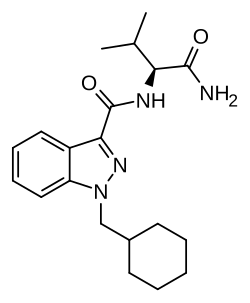
AB-CHMINACA is a synthetic cannabinoid receptor agonist from the indazole-3-carboxamide family. It was first reported in Europe in 2014 and became associated with outbreaks of severe intoxication, including delirium, seizures and deaths. Laboratory studies show that it is a potent CB1 receptor agonist, while forensic research has identified a range of metabolites that are useful for confirming exposure.
Chemistry and identification
AB-CHMINACA is an indazole-3-carboxamide with a cyclohexylmethyl group attached to the indazole nitrogen and an L-valinamide-derived substituent at the carboxamide position. It is closely related to ADB-CHMINACA, but the two differ in the amino-acid-derived side chain: AB-CHMINACA has a valine-derived group, whereas ADB-CHMINACA has a tert-leucine-derived group.
The compound was first reported to the European monitoring system in April 2014. It was found in herbal material and later appeared in powders and other products. The WHO reviewed it in 2017 and recommended international control after reports of serious harm (WHO critical review of AB-CHMINACA).
Pharmacology
AB-CHMINACA is a potent agonist at the CB1 cannabinoid receptor. In one functional assay, its reported EC50 was 7.4 nM. Experimental studies also found activation of CB1 and CB2 receptors and THC-like effects in animal drug-discrimination tests. Unlike THC, which generally acts as a partial agonist, AB-CHMINACA can produce full receptor activation in the systems studied (Banister and colleagues, 2015; CFSRE monograph, 2024).
Reported effects
Clinical reports describe a range of acute neuropsychiatric and physical effects. Unlike the comparatively familiar effects of cannabis, intoxication with potent synthetic cannabinoid agonists can be abrupt and unpredictable. Symptoms reported with AB-CHMINACA include confusion, delirium, agitation, unresponsiveness and seizures.
Neurological and behavioural effects
An outbreak investigation documented acute delirium in 24 patients and seizures in 14. Five patients required ventilatory support and intensive care. AB-CHMINACA or a predicted metabolite was confirmed in 15 of 21 tested cases; no deaths occurred in that particular outbreak (An outbreak of acute delirium from exposure to AB-CHMINACA, 2015).
Cardiovascular and systemic effects
Tachycardia, changes in blood pressure, vomiting and loss of consciousness have also been reported. Severe poisoning may involve respiratory compromise and complications secondary to seizures or prolonged agitation.
Clinical and forensic findings
The WHO review recorded 31 deaths with confirmed AB-CHMINACA exposure between 2014 and 2017. In at least seven cases, the substance was considered the cause of death or a contributing factor. A separate forensic report described sudden death associated with non-cardiogenic pulmonary oedema, with AB-CHMINACA and its metabolites detected in blood and tissues (AB-CHMINACA-induced sudden death from non-cardiogenic pulmonary oedema, 2017).
Metabolism and toxicology
Human liver microsome experiments identified 26 AB-CHMINACA metabolites, including hydroxylated, carboxylated and glucuronidated products. CYP3A4 was the most active of the tested enzymes in forming hydroxylated metabolites. Many of the metabolites identified in vitro were also detected in urine from a confirmed user, supporting their use as forensic biomarkers (Erratico and colleagues, 2015).
The clinical record establishes that AB-CHMINACA can cause life-threatening intoxication. However, concentrations and outcomes vary, and many cases involve uncertain product composition or additional substances. A single blood concentration cannot serve as a universal threshold for severity.
Related compounds
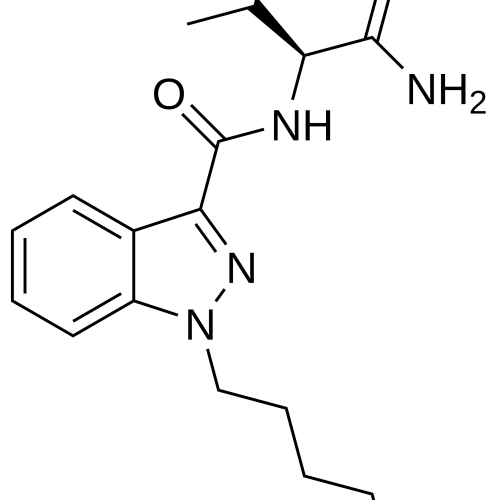
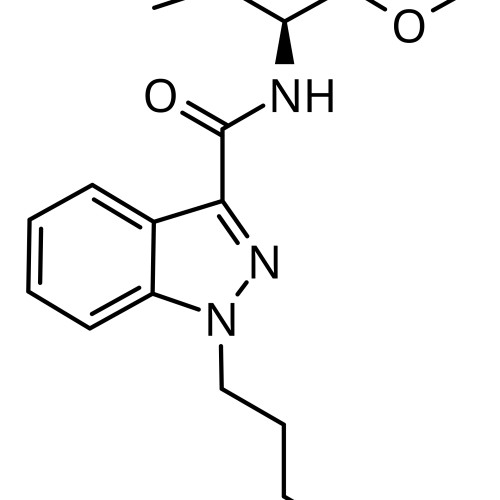
AB-CHMINACA is related to ADB-CHMINACA, AB-PINACA and AB-FUBINACA. These compounds share an indazole-carboxamide framework but differ in their nitrogen substituents and amino-acid-derived side chains.
Reviews
There are no reviews yet.