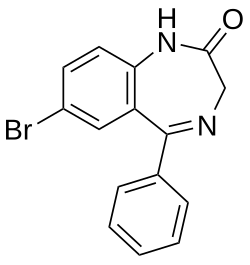
Bromonordiazepam, also known as desalkylgidazepam, is a long-acting benzodiazepine and the principal active metabolite of gidazepam. Gidazepam is a pharmaceutical anxiolytic used in some Eastern European countries. Desalkylgidazepam has also appeared independently on the new psychoactive substance market, where it is sometimes sold under the name bromonordiazepam. Its long elimination time and limited clinical data make interpretation of intoxication cases difficult.
Relationship to gidazepam
Gidazepam is a benzodiazepine prodrug: after administration, it is converted into desalkylgidazepam, which is responsible for much of its central nervous system activity. The metabolite is also called bromonordiazepam because of its structural relationship to nordiazepam and brominated benzodiazepines. It is important to distinguish the metabolite from gidazepam itself, since the two compounds have different pharmacokinetic profiles.
Gidazepam has been licensed for medical use in Ukraine and Russia. Desalkylgidazepam, however, has been identified in forensic samples in Europe, the United States and Canada as a designer benzodiazepine (Designer benzodiazepines gidazepam and desalkylgidazepam: What do we know?, 2023).
Pharmacology
Desalkylgidazepam acts through the GABAA receptor, the main target of benzodiazepines. Research on gidazepam and its metabolites describes activity at the benzodiazepine site, with desalkylgidazepam showing substantially greater receptor affinity than the parent drug. It has been characterised as a partial agonist in earlier pharmacological work.
A 2026 in-vitro comparison of prescription and designer benzodiazepines also found strong positive allosteric modulation of GABAA receptors by desalkylgidazepam. These laboratory results help clarify its activity, but they do not establish the intensity of its effects in a person or a clinical safety range (Communications Chemistry, 2026).
Pharmacokinetics
Available human data indicate that desalkylgidazepam is long acting. In a small pharmacokinetic study following administration of gidazepam, its active metabolite had an average elimination half-life of approximately 87 hours. The study included only five participants, so the estimate cannot be applied precisely to every individual.
The metabolite also has a relatively large volume of distribution, which is relevant when interpreting post-mortem blood concentrations. Its long persistence means that effects and detectable concentrations may continue well after the initial exposure. The review notes that the available human pharmacokinetic data come from studies of gidazepam rather than direct administration of desalkylgidazepam.
Reported effects
There is no well-established, compound-specific account of the subjective effects of bromonordiazepam. Reports generally describe benzodiazepine-like sedation and anxiolysis, but it is difficult to separate the effects of desalkylgidazepam from those of gidazepam and other substances detected in the same samples.
Central nervous system effects
Based on its GABAA activity, the expected effects include reduced anxiety, sedation, muscle relaxation and impaired psychomotor performance. Memory impairment and reduced coordination are also consistent with the broader benzodiazepine class. These effects are pharmacological expectations rather than a complete profile established through controlled studies of bromonordiazepam alone.
Forensic findings and safety
Desalkylgidazepam has been identified in post-mortem, impaired-driving and drug-facilitated crime investigations. A review of 63 forensic cases examined its blood concentrations and highlighted the difficulty of interpreting results when gidazepam or other benzodiazepines may also be involved (Desalkylgidazepam blood concentrations in 63 forensic investigations, 2023).
Its acute toxic range and long-term effects remain unclear. Its long persistence may contribute to accumulation with repeated exposure. As with other benzodiazepines, combining it with opioids, alcohol or other sedatives can increase central nervous system depression. Dependence and withdrawal are plausible, but have not been characterised in dedicated clinical studies.
Related compounds
Bromonordiazepam is closely related to Gidazepam, from which it is formed, and to nordiazepam and other long-acting benzodiazepines. It should not be confused with bromazepam or bromazolam, which are chemically distinct compounds.

Reviews
There are no reviews yet.