
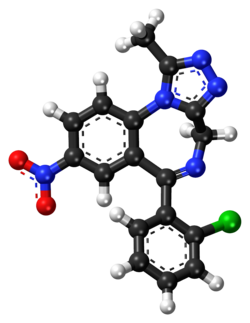
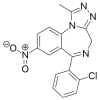
Clonazolam, also known as clonitrazolam, is a synthetic triazolobenzodiazepine related to clonazepam, triazolam and alprazolam. It has no recognised medical use and is known mainly from the designer-drug market, where it has been sold in tablets, powders and liquids, sometimes as counterfeit pharmaceutical benzodiazepines. Reports describe pronounced sedation and memory impairment, while clinical cases have documented severe central nervous system depression.
Chemistry and history
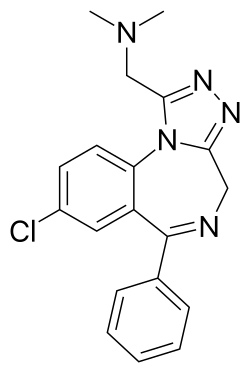
Clonazolam combines a benzodiazepine ring system with a fused triazole ring. It is structurally related to clonazepam, but has a methyl group and a nitro substituent in a different arrangement. The compound was first identified in seized products in Sweden in 2014 and was reported to European monitoring authorities in early 2015.
It has since been detected in several countries, including in tablets sold as alprazolam or diazepam. The WHO reviewed clonazolam in 2020 and recommended its inclusion in Schedule IV of the 1971 Convention on Psychotropic Substances (WHO Expert Committee on Drug Dependence, 2021).
Pharmacology
Clonazolam acts as a positive allosteric modulator at the benzodiazepine site of the GABAA receptor. It increases the effect of GABA, the main inhibitory neurotransmitter in the central nervous system. Its pharmacological action is similar to that of established benzodiazepines, although the limited data and reports of marked effects have raised concerns about its potency.
The WHO review found no controlled studies of its dependence or abuse potential in humans or animals. Its mechanism of action and similarity to other benzodiazepines nevertheless suggest that it can produce dependence.
Subjective effects
The PsychonautWiki profile of clonazolam describes strong sedation and anxiety relief, with recurring accounts of amnesia and impaired coordination. These descriptions are based mainly on user accounts rather than controlled clinical studies.
Physical effects
Sedation and muscle relaxation are prominent. Users report dizziness, slurred speech, reduced motor control and a tendency to become unsteady or unusually lethargic. Severe intoxication can progress to profound sleepiness or unconsciousness.
Cognitive effects
Anxiety suppression and disinhibition are frequently described. Memory impairment is a particular concern: some reports describe substantial gaps in memory, including periods during which a person may continue to act without later recalling what happened. Confusion and delayed responses are also reported.
Clinical intoxication and harm
Cases of clonazolam poisoning have been managed in emergency departments and intensive care units. Reported presentations include severe sedation, confusion, unconsciousness and impaired motor function. Clonazolam has also been detected in impaired-driving investigations, often alongside other substances.
The WHO review notes that clonazolam can intensify the effects of opioids and other depressants. A review of designer benzodiazepines describes cases in which central nervous system depression was the main adverse effect following exposure to clonazolam, sometimes in combination with etizolam (Brunetti and colleagues, 2021).
Dependence and withdrawal
There are no controlled studies that quantify clonazolam dependence, but user reports describe tolerance, withdrawal symptoms and difficulty stopping repeated use. These reports are consistent with its action at the benzodiazepine site. Abrupt cessation after regular use can cause severe withdrawal, including seizures; withdrawal from benzodiazepines should be managed with medical supervision.
Related compounds
Clonazolam is related to Clonazepam, Alprazolam and Triazolam. Its fused triazole ring places it in the triazolobenzodiazepine subgroup.

Reviews
There are no reviews yet.