
JWH-200, also known as WIN 55,225, is a synthetic cannabinoid in the naphthoylindole family. It differs from many early JWH compounds because its indole nitrogen carries a morpholinoethyl substituent rather than a straight alkyl chain. It binds to cannabinoid receptors and has been identified in herbal smoking products, although its receptor affinity is lower than that of several other naphthoylindoles.
Chemistry and identification
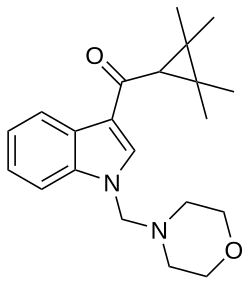
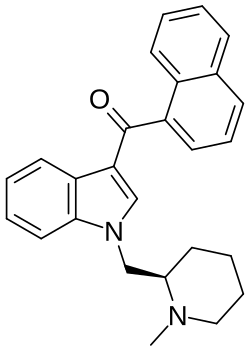
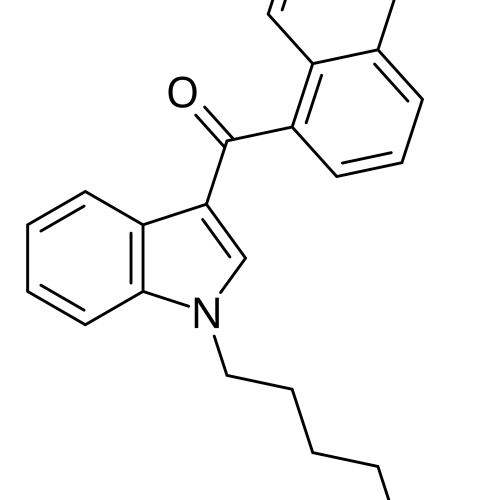
JWH-200 is [1-[2-(4-morpholinyl)ethyl]-1H-indol-3-yl](1-naphthyl)methanone. It contains a naphthoylindole core and a morpholine-containing side chain attached to the indole nitrogen. This makes it structurally distinct from JWH-018 and JWH-073, which carry pentyl and butyl chains, respectively.
JWH-200 was identified in commercial herbal smoking mixtures in the United States. A 2012 forensic study found it alongside JWH-018, JWH-073, JWH-210 and other synthetic cannabinoids in products sold as incense or herbal blends (Logan and colleagues, 2012).
Pharmacology
Published binding data report a CB1 Ki of approximately 42 nM for JWH-200, indicating measurable but comparatively weaker affinity than JWH-018 or JWH-210 in the same broad group. The compound has also been examined as a cannabinoid receptor ligand in early structure–activity studies (Comparative cannabinoid receptor affinity data).
The morpholinoethyl substituent changes the physicochemical properties of the molecule compared with the N-pentyl JWH compounds. Receptor-binding affinity alone does not establish its functional efficacy, subjective intensity or clinical risk.
Reported effects
There is limited compound-specific human information about JWH-200. Its detection in herbal smoking products establishes that it entered the recreational market, without reliably establishing what individual users experienced.
Reports involving synthetic cannabinoid mixtures include altered perception, sedation, anxiety, confusion and cardiovascular symptoms. These class-level observations should not be presented as a confirmed symptom profile for JWH-200 itself.
Toxicity and research limitations
No well-characterised clinical case series or human metabolism study specific to JWH-200 was identified in the sources reviewed here. Its acute toxic range, dependence potential and long-term effects remain uncertain. The 2012 identification study also found multiple active compounds in some products, which helps explain why clinical reactions cannot always be attributed to one ingredient.
JWH-200 should be distinguished from WIN 55,212-2, a separate aminoalkylindole cannabinoid often used as a laboratory reference compound. Similar WIN/JWH numbering does not mean that they are the same substance.
Related compounds
JWH-200 is related to JWH-018, JWH-073 and JWH-210. Its morpholinoethyl group distinguishes it from the straight-chain alkyl analogues.

Reviews
There are no reviews yet.