
Escaline, or 4-ethoxy-3,5-dimethoxyphenethylamine, is a synthetic psychedelic in the mescaline-derived scaline family. It differs from mescaline by having an ethoxy group rather than a methoxy group at the 4-position of the phenyl ring. Human descriptions are largely anecdotal, while laboratory studies have examined its interaction with serotonin receptors and its relationship to other mescaline analogues.
Chemistry and relationship to mescaline
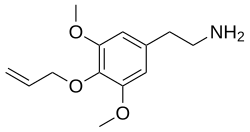
Escaline retains the phenethylamine backbone and the 3,5-dimethoxy substitution pattern of mescaline. Its 4-ethoxy group is one carbon longer than mescaline’s 4-methoxy group. It is the parent phenethylamine for proscaline and is related to allylescaline and methallylescaline, which carry different oxygen-linked side chains.
The term “scaline” is used for mescaline analogues with modifications at the 4-position of the aromatic ring. These changes can alter receptor affinity and reported subjective effects, even when the compounds share the same basic phenethylamine structure.
Pharmacology
A 2022 receptor study examined escaline alongside other scalines and their alpha-methylated analogues. Escaline showed measurable affinity at the 5-HT2A receptor, with weaker or variable activity at other serotonin and non-serotonergic targets. The study found that extending the 4-alkoxy substituent generally increased 5-HT2A and 5-HT2C affinity across the compounds examined (Kolaczynska and colleagues, 2022).
A mouse head-twitch study also examined escaline and proscaline as mescaline analogues. The response is used as a behavioural model of 5-HT2A-mediated psychedelic activity, but it does not directly measure human subjective effects (Comparison of the behavioural effects of mescaline analogues, 2019).
Subjective effects
The PsychonautWiki profile of escaline and historical accounts describe a psychedelic experience related to mescaline. Detailed human reports are scarce, making comparisons with mescaline approximate rather than clinically established.
Visual and cognitive effects
Reports describe changes in colour and visual detail, geometric patterning, altered perception of movement and shifts in thought or mood. Introspection and unusual associations are also mentioned. The available accounts do not establish how consistently these effects occur.
Physical effects
Reported physical effects include stimulation, nausea, bodily tension and changes in heart rate. Some accounts describe a gradual onset and a prolonged experience, but there are no controlled human pharmacokinetic studies that establish a reliable duration for escaline.
Toxicity and research limitations
Clinical toxicology data specific to escaline are scarce. The available evidence consists mainly of receptor assays, animal behavioural studies and anecdotal human descriptions. No well-characterised clinical case series has established its acute toxic range, metabolism, dependence potential or long-term effects.
Findings from mescaline or other scalines provide context, but should not be treated as direct evidence about escaline. The effects of a 4-alkoxy substitution depend on the size and shape of the substituent and cannot be inferred from the name alone.
Related compounds
Escaline is related to Mescaline, Proscaline, Allylescaline and Methallylescaline. It is the 4-ethoxy analogue of mescaline and the parent phenethylamine for proscaline.
Reviews
There are no reviews yet.