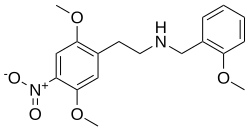
25N-NBOMe is a synthetic psychedelic in the N-benzylphenethylamine family. It is the N-(2-methoxybenzyl) derivative of a nitro-substituted 2C phenethylamine, with a nitro group at the 4-position of the aromatic ring. The compound has been characterised in receptor studies, which found very high activity at serotonin 5-HT2A and 5-HT2C receptors. Human effects and toxicity have not been adequately documented.
Chemistry and nomenclature
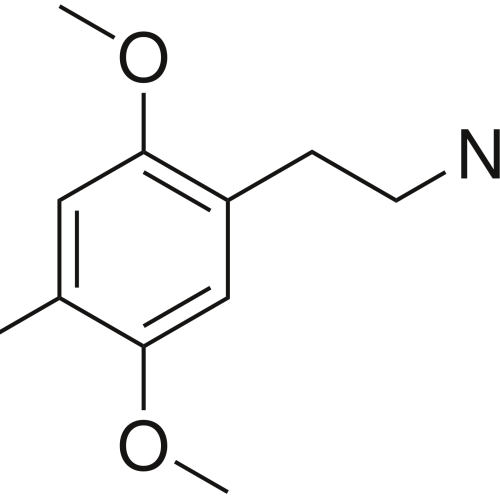
25N-NBOMe is based on 2,5-dimethoxyphenethylamine, with a nitro group at the 4-position and a 2-methoxybenzyl group attached to the nitrogen. In this name, the “N” in 25N refers to the nitro substituent on the phenyl ring; “NBOMe” refers separately to the N-(2-methoxybenzyl) group.
The abbreviation can therefore be confusing. 25N-NBOMe is not simply an unsubstituted NBOMe analogue, and it should not be confused with 25H-NBOMe, which lacks the 4-nitro group.
Pharmacology
A comparative in-vitro study of N-benzylphenethylamines found that 25N-NBOMe had very high affinity for the 5-HT2A and 5-HT2C receptors. Functional assays showed full agonist activity at both receptors, with subnanomolar-to-low-nanomolar potency at 5-HT2A. Its activity at monoamine transporters was much weaker, supporting a predominantly serotonergic rather than conventional stimulant profile (Neurochemical pharmacology of substituted N-benzylphenethylamines, 2018).
These findings come from laboratory receptor systems. They do not establish the intensity of subjective effects or a human toxicity range.
Subjective effects
Reliable human accounts are too limited to establish a characteristic 25N-NBOMe experience. Its receptor activity is consistent with psychedelic potential, but no substantial collection of controlled human observations or analytically confirmed clinical cases was identified in the available literature.
Effects described for other NBOMe compounds, such as visual patterning, altered perception, agitation or autonomic stimulation, should not automatically be attributed to 25N-NBOMe. The chemical family provides context, not a substitute for compound-specific evidence.
Toxicity and research limitations
No detailed clinical case series has established the acute toxicity, metabolism or long-term effects of 25N-NBOMe. Its very high receptor activity in vitro warrants attention, but receptor potency alone cannot predict the likelihood or severity of poisoning in people.
There is also little information about its stability, metabolites or forensic detection in biological samples. The absence of published clinical reports should be read as a research gap rather than evidence of safety.
Related compounds
25N-NBOMe is related to 25D-NBOMe, 25E-NBOMe, 25H-NBOMe and other N-benzylphenethylamines. It differs from these compounds by the nitro group at the 4-position of its phenyl ring.
Reviews
There are no reviews yet.