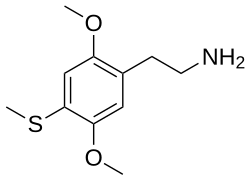
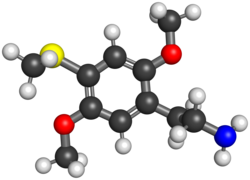
2C-T, or 4-methylthio-2,5-dimethoxyphenethylamine, is a synthetic psychedelic in the 2C-T series of sulfur-substituted phenethylamines. It differs from the better-known 2C compounds by a methylthio group at the 4-position of the phenyl ring. Human information is largely historical and anecdotal, while newer laboratory research has begun to clarify how 2C-T compounds interact with serotonin receptors.
Chemistry and relationship to the 2C-T series
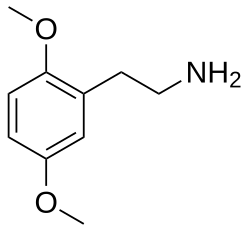
2C-T has the standard 2,5-dimethoxyphenethylamine backbone, with a methylthio substituent at the 4-position. It is the parent member of a group that includes 2C-T-2, with an ethylthio group, and 2C-T-7, with a propylthio group. The sulfur-containing substituent distinguishes these compounds from the more familiar halogenated and alkyl-substituted 2C psychedelics.
Although 2C-T is sometimes discussed alongside the amphetamine-derived ALEPH compounds, it is a phenethylamine: it does not have the alpha-methyl group found in those amphetamine analogues.
Pharmacology
A 2022 structure–activity study of 4-thio-substituted phenethylamines found that 2C-T interacts with serotonin receptors, particularly 5-HT2A and 5-HT2C. Across the 2C-T compounds examined, receptor affinity was in the nanomolar range, and the compounds acted as partial agonists at 5-HT2A. They showed little activity at monoamine transporters in the assays used (Luethi and colleagues, 2018; 4-thio-substituted phenylalkylamine structure–activity study, 2022).
The 2022 animal study found relatively low potency for 2C-T in the mouse head-twitch response compared with several longer-chain thio analogues. This behavioural test is used as a model of 5-HT2A-mediated psychedelic activity; it does not measure human subjective effects.
Subjective effects
The PsychonautWiki profile of 2C-T and historical accounts describe psychedelic effects, but detailed human accounts are scarce. Descriptions associated with the wider 2C-T group include changes in visual perception, altered thought patterns and emotional shifts. These descriptions of the wider group do not confirm the effects of 2C-T itself.
The evidence is too inconsistent to establish the typical balance of visual, cognitive and physical effects. In particular, the more extensive reports concerning 2C-T-2 and 2C-T-7 should not be transferred directly to the parent compound.
Toxicity and research limitations
No well-characterised clinical case series has established the acute toxicity of 2C-T. The 2022 receptor and animal studies add information about its pharmacology, but there are no adequate human pharmacokinetic studies or reliable data on dependence and long-term effects.
Research on the metabolism of related 2C compounds has identified deamination and O-demethylation as important pathways. MAO-A and MAO-B are involved in deamination across several studied 2C substances, but compound-specific human data for 2C-T remain limited (Theobald and Maurer, 2007).
Related compounds
2C-T is related to 2C-T-2 and 2C-T-7, which have longer alkylthio substituents. It is also related to the broader 2C family of substituted phenethylamine psychedelics.
Reviews
There are no reviews yet.