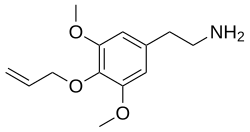
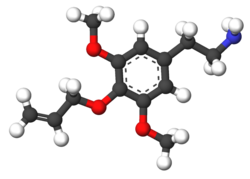
Allylescaline, also known as 4-allyloxy-3,5-dimethoxyphenethylamine, is a synthetic psychedelic in the mescaline-derived scaline family. It is structurally related to mescaline and escaline, with an allyloxy group at the 4-position of the phenyl ring. Its human effects are described mainly in historical and anecdotal accounts; dedicated pharmacological and toxicological research remains very limited.
Chemistry and relationship to mescaline
Allylescaline has the 3,5-dimethoxyphenethylamine backbone found in mescaline-related compounds. The 4-position carries an allyloxy group rather than the methoxy group found in mescaline or the ethoxy group found in escaline. It is also related to 3C-E and 3C-P, which are alpha-methylated amphetamine counterparts of the scaline family.
Pharmacology
There is little direct receptor research specific to allylescaline. Its psychedelic classification is based on historical human descriptions and its structural relationship to mescaline-derived compounds. A 2022 study examined several scalines and 3C-scalines, including the amphetamine analogue 3C-AL, but did not provide a direct receptor profile for allylescaline itself (Kolaczynska and colleagues, 2022).
The 3C-AL findings should not be transferred directly to allylescaline. The additional alpha-methyl group changes the molecule and may alter receptor interactions and metabolism.
Subjective effects
The PsychonautWiki profile of allylescaline draws mainly on user reports and historical descriptions. Alexander Shulgin also discussed the compound in PiHKAL. The few detailed accounts available describe a mescaline-like psychedelic experience.
Visual and cognitive effects
Reports mention visual changes, introspection, conceptual thinking, altered time perception and euphoria. Some accounts describe less pronounced visual and cognitive effects than mescaline, while others emphasise the physical aspects of the experience. These descriptions are anecdotal and do not establish a consistent profile.
Physical effects
Reported physical effects include stimulation, bodily warmth, tactile changes and nausea. Increased heart rate has also been mentioned. There are not enough clinical observations to determine the frequency or severity of these reactions.
Toxicity and research limitations
No well-characterised clinical case series or controlled human pharmacokinetic study has established the acute toxicity, metabolism, dependence potential or long-term effects of allylescaline. With so little documented use, rare adverse events are difficult to assess.
Receptor findings for mescaline, escaline or 3C-AL provide chemical context but are not direct evidence of allylescaline’s pharmacology. The available literature does not support a detailed clinical safety profile.
Related compounds
Allylescaline is related to Mescaline, Escaline, Proscaline, 3C-E and 3C-P. It is the allyloxy analogue of mescaline and the non-alpha-methyl counterpart of 3C-AL.
Reviews
There are no reviews yet.