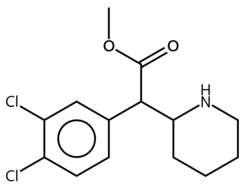
3,4-CTMP, also known as 3,4-dichloromethylphenidate, is a synthetic stimulant in the phenidate family. It is a dichlorinated analogue of methylphenidate, with chlorine atoms at the 3- and 4-positions of the phenyl ring. The compound appeared on the new psychoactive substance market in the early 2010s and has been examined in transporter assays and metabolism studies, but human clinical data remain limited.
Chemistry and history
3,4-CTMP retains the methylphenidate structure, including the piperidine ring and methyl ester, but has two chlorine substituents on the aromatic ring. It is distinct from 3,4-dichloroethylphenidate, which carries an ethyl ester rather than a methyl ester.
The compound appeared in the UK research-chemical market in 2013. It was sold as a stimulant analogue of methylphenidate, although the information available at the time was largely based on its chemical structure and user reports.
Pharmacology
An in-vitro study of methylphenidate-based designer drugs found that 3,4-CTMP inhibits the dopamine transporter (DAT) and norepinephrine transporter (NET) much more potently than the serotonin transporter. Like methylphenidate, it did not produce transporter-mediated monoamine efflux in the assay. Several compounds in the study also interacted with adrenergic and serotonergic targets, but the overall profile was dominated by DAT and NET inhibition (Luethi and colleagues, 2018).
A separate rat brain-slice study found that 3,4-CTMP altered evoked dopamine and norepinephrine efflux in the nucleus accumbens and bed nucleus of the stria terminalis. These experimental results are not equivalent to direct neurotransmitter release by a transporter substrate; they were observed in tissue preparations following electrical stimulation (Davidson and colleagues, 2018).
Subjective effects
The PsychonautWiki profile of 3,4-CTMP draws mainly on user accounts of stimulant effects and comparisons with methylphenidate or cocaine, but there are no controlled human studies establishing a typical experience.
Accounts mention increased wakefulness and focus, alongside anxiety, restlessness and cardiovascular stimulation. These descriptions should be treated as anecdotal rather than as a reliable clinical profile.
Metabolism and forensic research
A 2019 analytical study examined the metabolism of 3,4-CTMP, 4-fluoromethylphenidate and isopropylphenidate. In rat urine, seven phase I metabolites of 3,4-CTMP were identified. Incubation with pooled human liver S9 fractions indicated that hydrolysis to the corresponding carboxy metabolite was an important pathway. These findings provide useful targets for forensic screening (Metabolite identification of methylphenidate-derived NPS, 2019).
Toxicity and research limitations
There is no well-established human toxic range for 3,4-CTMP, and published clinical case data are sparse. Its DAT and NET activity is consistent with stimulant effects, but does not establish the frequency of acute cardiovascular or psychiatric complications.
Dependence potential and long-term effects have not been characterised in controlled human studies. Research on methylphenidate or other phenidates offers context, but no direct evidence about 3,4-CTMP.
Related compounds
3,4-CTMP is related to 4F-MPH, Ethylphenidate, Isopropylphenidate and methylphenidate. It is the dichlorinated methyl ester analogue in the wider phenidate group.

Reviews
There are no reviews yet.