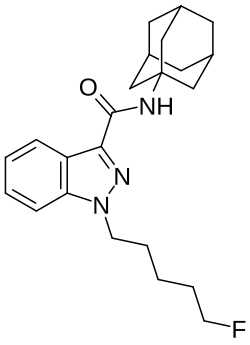
5F-AKB48, also known as 5F-APINACA, is a synthetic cannabinoid in the adamantyl-indazole-carboxamide family. It is a fluorinated analogue of AKB48, with a 5-fluoropentyl chain attached to the indazole nitrogen. Laboratory studies show that it is a potent CB1 receptor agonist and that several of its metabolites retain cannabinoid activity. It has been detected in fatal and non-fatal forensic cases.
Chemistry and history
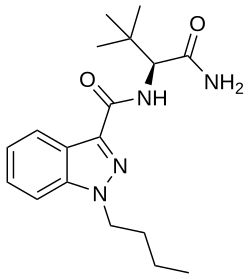
5F-AKB48 is N-(adamantan-1-yl)-1-(5-fluoropentyl)-1H-indazole-3-carboxamide. Its structure combines an indazole core, an adamantyl amide group and a fluorinated pentyl tail. It is related to AKB48, also known as APINACA, but the terminal fluorine changes its metabolic profile and pharmacological activity.
The compound was identified in drug materials and toxicology samples during the expansion of third- and fourth-generation synthetic cannabinoids. It has been included in international forensic guidance and drug-monitoring lists (UNODC recommended methods for synthetic cannabinoid analysis).
Pharmacology
5F-AKB48 acts as a potent agonist at the CB1 receptor. In a 2020 study, it showed high-affinity binding and full agonist activity in a G-protein activation assay. In mice, it produced cannabimimetic effects that were more potent but shorter acting than those of Δ9-THC under the conditions tested (Pinson and colleagues, 2020).
The same study found that the hydroxylated metabolite 4-OH-5F-AKB48 retained high CB1 affinity and showed substantial functional activity. This is relevant because metabolism does not necessarily eliminate the biological activity of synthetic cannabinoids.
Metabolism
Human microsomal and recombinant-enzyme experiments identified successive hydroxylation pathways, producing mono-, di- and trihydroxylated metabolites. CYP2D6, CYP2J2, CYP3A4 and CYP3A5 contributed to the transformations, with CYP3A4/5 producing several of the more extensively hydroxylated products. Defluorination was also observed in the experimental systems (Pinson and colleagues, 2020).
Reported effects and clinical findings
Human reports of synthetic cannabinoid exposure include altered mental status, agitation, anxiety, hallucinations, tachycardia, seizures and loss of consciousness. These effects are well documented for the broader class, but individual case reports involving 5F-AKB48 often include other substances.
A forensic report described a rapid death involving both 5F-AKB48 and 5F-PB-22, alongside a substantial alcohol concentration. The authors attributed the death to the combined effects of alcohol and synthetic cannabinoids rather than to 5F-AKB48 alone (Synthetic cannabinoids and rapid death, 2018).
Toxicity and research limitations
The combination of potent CB1 agonism and biologically active metabolites is a significant toxicological concern. However, post-mortem cases involving several substances cannot establish a simple toxicity threshold based on concentration. Long-term human effects and dependence potential have not been fully characterised.
Related compounds
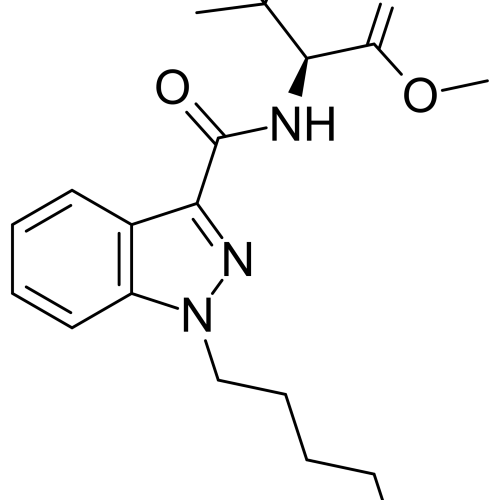
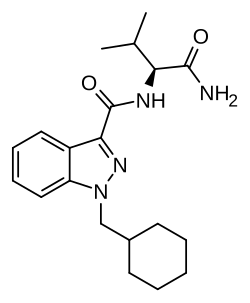
5F-AKB48 is related to AKB48, 5F-PB-22, 5F-ADB and other fluorinated synthetic cannabinoids. Its adamantyl group distinguishes it from the valinate-based indazole-carboxamides.
Reviews
There are no reviews yet.