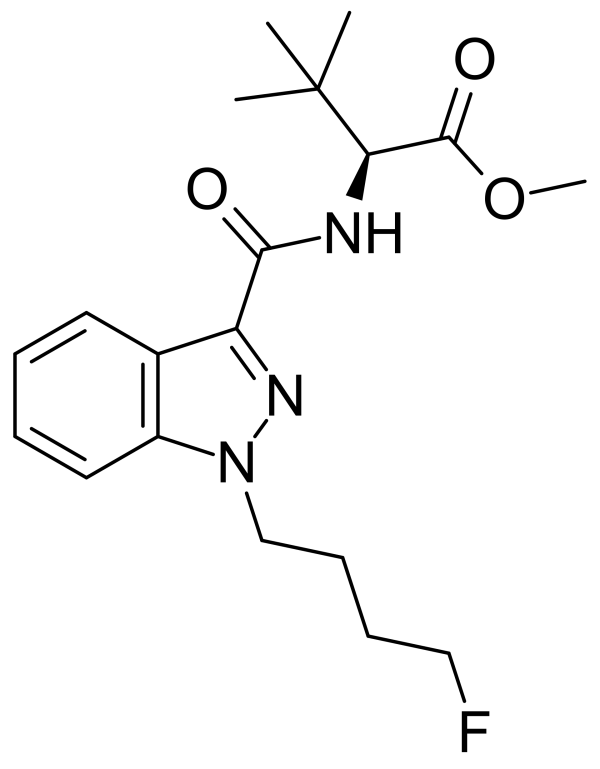
4F-ADB is a name used for a fluorinated indazole-carboxamide synthetic cannabinoid. The abbreviation is not fully consistent across chemical and forensic sources: the UNODC database lists 4F-ADB as 4-fluoro-MDMB-PINACA, with a 4-fluoropentyl chain, while other publications and databases have used similar shorthand for a 4-fluorobutyl analogue. That distinction matters because these are different chemical structures, not interchangeable names.
Chemistry and nomenclature
In the UNODC entry, 4F-ADB is identified as methyl 2-(1-(4-fluoropentyl)-1H-indazole-3-carboxamido)-3,3-dimethylbutanoate. It belongs to the indazole-carboxamide group of synthetic cannabinoid receptor agonists. The same entry lists 4-fluoro-ADB and 4-fluoro-MDMB-PINACA as names for this structure (UNODC substance record: 4-fluoro-ADB).
Some literature tables use 4F-ADB alongside 4F-MDMB-BINACA, a related structure with a 4-fluorobutyl rather than 4-fluoropentyl chain. The abbreviation alone therefore does not guarantee a unique identity. Analytical reports should be checked for the full structure or a confirmed reference standard before results are attributed to one specific isomer (Zangani and colleagues, 2020).
Pharmacology
The UNODC classifies the 4-fluoro-ADB structure in its database as a synthetic cannabinoid receptor agonist. However, detailed compound-specific receptor assays and human pharmacology are not as well documented as they are for some related compounds. Findings for 5F-ADB or 4F-MDMB-BINACA should not be transferred to 4F-ADB without confirming that the chemical structures match.
Reported effects
Reliable human evidence is too limited to define a characteristic 4F-ADB experience. Synthetic cannabinoid receptor agonists can produce cannabis-like perceptual effects, but many newer compounds act differently from THC and may cause much more severe central nervous system and cardiovascular reactions. These class-level observations are not a confirmed symptom profile for every substance carrying the 4F-ADB label.
Toxicity and research limitations
No well-characterised clinical case series specific to the UNODC-defined 4-fluoro-ADB structure was identified in the sources reviewed here. Its acute toxic range, metabolism, dependence potential and long-term effects remain poorly characterised. The ambiguous abbreviation also makes it possible to confuse toxicology results from different compounds.
Forensic interpretation should distinguish the 4-fluoropentyl structure listed by UNODC from the 4-fluorobutyl analogue reported elsewhere. Without that distinction, receptor and clinical findings may be assigned to the wrong substance.
Related compounds
4F-ADB is structurally related to 5F-ADB, 4F-AMB and other indazole-carboxamide cannabinoids. The position of fluorine and the length of the N-alkyl chain distinguish these compounds.

Reviews
There are no reviews yet.