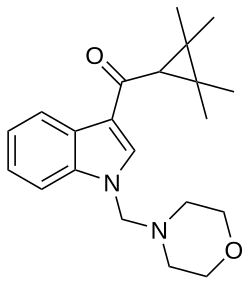
A-834,735 is a synthetic indole-derived cannabinoid developed as a research ligand for cannabinoid receptors. It is a full agonist at both CB1 and CB2 receptors in rat assays and was investigated for its analgesic effects in preclinical pain models. Unlike many newer synthetic cannabinoids found in recreational products, A-834,735 was primarily studied as an experimental pharmacological compound.
Chemistry and research background
A-834,735 contains an indole core with a tetramethylcyclopropyl methanone substituent and a tetrahydropyran-containing side chain. It belongs to the indole-derived cannabinoid research series. Its structure is distinct from the indazole-carboxamide compounds that became common in later generations of synthetic cannabinoid products.
Pharmacology
Experimental data describe A-834,735 as a full agonist at both CB1 and CB2 receptors in rat systems. Reported binding affinities were 4.6 nM at CB1 and 0.31 nM at CB2, with functional EC50 values of 12 nM and 0.21 nM, respectively. These figures come from preclinical assays and should not be interpreted as human potency estimates (Cayman Chemical: A-834,735 research summary).
The compound readily crossed the blood–brain barrier in the reported animal work. It reversed thermal hyperalgesia in a rat neuropathic pain model, providing a basis for its use as a pharmacological research tool.
Effects in experimental models
The available research describes cannabinoid-like activity and antinociceptive effects in rodents. Because A-834,735 activates CB1 as well as CB2, its pharmacology differs from CB2-selective compounds such as A-796,260.
There are no controlled human studies or reliable user reports establishing a characteristic subjective experience. Effects observed in rodents cannot predict the recreational experience in humans.
Toxicity and research limitations
The available sources yielded no detailed human clinical toxicology data, pharmacokinetic study or therapeutic trial. Its acute toxic range, metabolism, dependence potential and long-term effects in humans remain unknown.
Although A-834,735 is listed in synthetic cannabinoid monitoring resources, its research history should be distinguished from that of compounds developed or encountered primarily as recreational drugs. Its receptor activity is established in preclinical models; human safety and clinical utility are not.
Related compounds
A-834,735 is related to A-796,260 and other indole-derived cannabinoid research ligands. The principal distinction is its activity at both CB1 and CB2 receptors rather than selective CB2 agonism.
Reviews
There are no reviews yet.