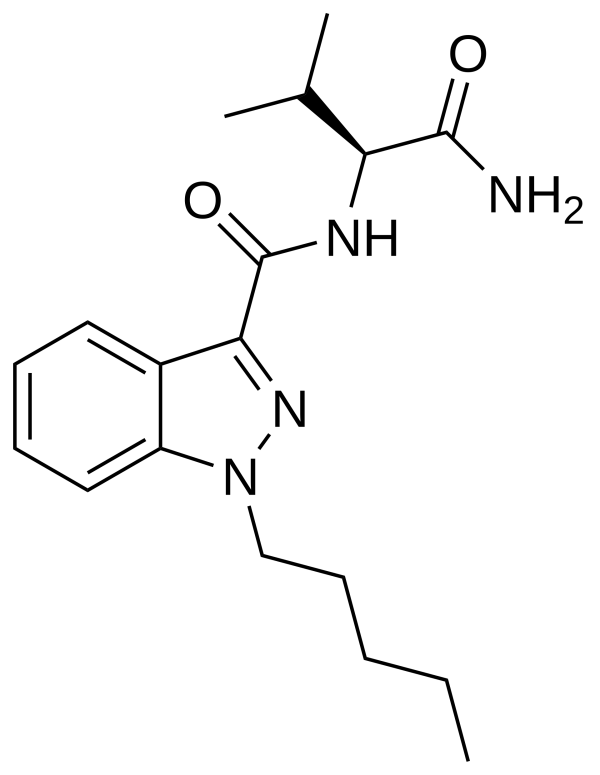
AB-PINACA is a synthetic cannabinoid in the indazole-3-carboxamide family. It was identified in herbal smoking mixtures in 2013 and later appeared in clinical toxicology investigations. Laboratory studies show that it is a potent full agonist at cannabinoid receptors, while human case reports describe agitation, confusion, seizures and other severe reactions.
Chemistry and identification
AB-PINACA is N-(1-amino-3-methyl-1-oxobutan-2-yl)-1-pentyl-1H-indazole-3-carboxamide. It contains an indazole core, a straight pentyl chain attached to the indazole nitrogen and a valine-derived amide group. It is closely related to ADB-PINACA, which has a tert-leucine-derived side chain, and to AB-CHMINACA, which carries a cyclohexylmethyl substituent instead of the pentyl chain.
AB-PINACA was first reported to the European monitoring system in May 2013 after it was detected in an herbal mixture in Sweden. It was also identified in products sold in Japan (EUDA: Synthetic cannabinoids in Europe).
Pharmacology
AB-PINACA is a high-efficacy agonist at the CB1 and CB2 receptors. In comparative experiments, it produced cannabinoid-like effects in mice, including suppression of locomotor activity, antinociception, hypothermia and catalepsy. It also substituted for THC in drug-discrimination experiments, supporting a THC-like subjective signal in the animal model (Banister and colleagues, 2015).
Later research found that AB-PINACA has atypical signalling properties at CB1 receptors compared with THC. This may be one factor contributing to the more pronounced adverse reactions reported with some synthetic cannabinoids (Atypical pharmacodynamic properties and metabolic profile of AB-PINACA, 2018).
Reported effects
Clinical descriptions of AB-PINACA exposure include altered mental status, agitation, confusion, lethargy, seizures, tachycardia, hypertension and hallucinations. As with other potent synthetic cannabinoids, symptoms may be severe and may differ from the effects expected from cannabis.
Neurological and behavioural effects
A six-patient case series described varying degrees of altered mental status, agitation and seizures after suspected synthetic cannabinoid exposure. AB-PINACA and its metabolites were analytically confirmed in two patients, together with ADB-PINACA in the same investigation (Armenian and colleagues, 2018).
Metabolism and forensic findings
Human urine and serum analyses have identified monohydroxylated metabolites, including 4-hydroxy and 5-hydroxy products. These metabolites can be important because the parent compound may be difficult to detect after extensive metabolism. Some non-acidic metabolites retain cannabinoid receptor activity in vitro, meaning that metabolism does not necessarily eliminate all biological activity immediately (AB-PINACA pharmacodynamic and metabolic study, 2018; Metabolite pharmacology of APICA and ADB-PINACA, 2017).
AB-PINACA has also been detected in post-mortem tissue in a mixed-drug fatality involving other synthetic cannabinoids and a synthetic cathinone. The presence of multiple substances prevented a simple attribution of the death to AB-PINACA alone (Yamagishi and colleagues, 2018).
Toxicity and research limitations
The available evidence supports a risk of serious acute intoxication, particularly neurological and cardiovascular complications. Many case reports involve exposure to other substances, and no single concentration threshold reliably predicts severity. Controlled human studies have not fully characterised its long-term effects or dependence potential.
Related compounds
AB-PINACA is related to ADB-PINACA, AB-FUBINACA and AB-CHMINACA. These compounds share an indazole-carboxamide scaffold but differ in the nitrogen substituent and amino-acid-derived side chain.

Reviews
There are no reviews yet.