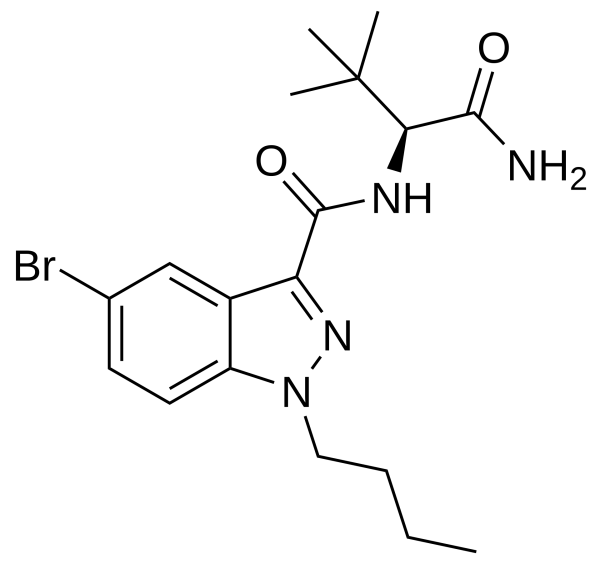
5Br-ADB-INACA, more commonly listed by UNODC as ADB-5Br-INACA, is a brominated indazole-carboxamide compound included in synthetic cannabinoid monitoring. Its structure contains a 5-bromoindazole core and an ADB-type amino-oxo-butane carboxamide substituent. Unlike many established synthetic cannabinoid receptor agonists, its cannabinoid activity is not well established and recent in-vitro data suggest weak or undetectable activity in the assay examined.
Chemistry and identification
UNODC identifies ADB-5Br-INACA as N-(1-amino-3,3-dimethyl-1-oxobutan-2-yl)-5-bromo-1H-indazole-3-carboxamide. The database lists the compound under the synthetic cannabinoid substance group, but assigns its effect group as unassigned. The name 5Br-ADB-INACA is a reversed form of the same shorthand used in some monitoring lists (UNODC substance record: ADB-5Br-INACA).
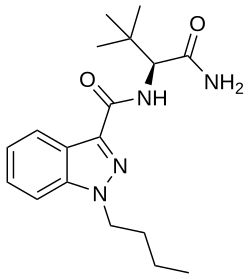
It is important not to confuse this compound with ADB-5Br-BUTINACA or ADB-D-5Br-INACA. Those names refer to different structures, including different nitrogen substitution or alkyl-chain features.
Pharmacology
There is little historical pharmacological information specific to ADB-5Br-INACA. A 2026 comparative study of synthetic cannabinoid chemotypes found that ADB-5Br-INACA, alongside several other INACA compounds, had micromolar or unmeasurable affinity and potency in the cannabinoid receptor assays used. This contrasts with the nanomolar activity seen in many PINACA, BUTINACA and PICA compounds (Chemotype-dependent dissociation of binding affinity and functional potency in synthetic cannabinoids, 2026).
The result is specific to the experimental system and does not prove that the substance has no biological activity under all conditions. It does, however, show why a structural label alone is not enough to assume potent CB1 agonism.
Reported effects
No reliable human effect profile has been established for ADB-5Br-INACA. The available sources establish no clinical syndrome and contain no controlled observations of subjective effects. They also offer no evidence that it produces the effects commonly associated with more potent synthetic cannabinoids.
Toxicity and research limitations
No compound-specific clinical case series, metabolism study or human toxicological assessment was identified in the available literature. Its acute toxicity, metabolism, dependence potential and long-term effects remain unknown.
The 2026 receptor study suggests that ADB-5Br-INACA may have substantially lower cannabinoid receptor activity than many related compounds. This is a laboratory finding, not a human safety assessment. Analytical confirmation remains important because closely named brominated INACA compounds can have different structures and pharmacological properties.
Related compounds
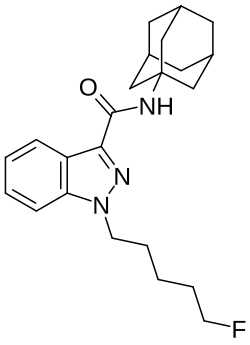
ADB-5Br-INACA is related by chemical scaffold to 5F-ADB, 4F-ADB and other indazole-carboxamide cannabinoids. Its 5-bromoindazole core and unsubstituted indazole nitrogen distinguish it from many more potent members of the group.

Reviews
There are no reviews yet.