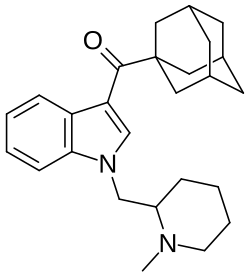
AM-1248 is a synthetic cannabinoid in the adamantoylindole family. It was developed as a research ligand for cannabinoid receptors and later appeared in herbal smoking mixtures identified by European monitoring systems. Laboratory studies describe activity at both CB1 and CB2 receptors, while animal self-administration research has demonstrated reinforcing effects. Human clinical information remains limited.
Chemistry and identification
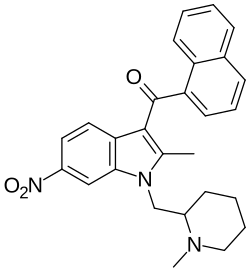
AM-1248 contains an indole core with an adamantoyl group attached at the 3-position and an N-(1-methylpiperidin-2-yl)methyl substituent. It is structurally distinct from AM-1220, which carries a naphthoyl group, and from APICA, which contains an adamantyl carboxamide rather than an adamantoyl ketone.
AM-1248 was reported in a German herbal smoking mixture in September 2012. EUDA classifies it as an adamantoylindole cannabinoid receptor agonist (EUDA: Synthetic cannabinoids in Europe).
Pharmacology
In vitro binding studies report affinity at both cannabinoid receptor subtypes, with Ki values of approximately 11.9 nM at CB1 and 4.8 nM at CB2. These measurements suggest a modest preference for CB2, rather than the strong selectivity seen with some experimental CB2 ligands. The compound has been described as a moderately potent agonist at both receptors (Makriyannis and Deng, 2007).
Effects in experimental models
AM-1248 has been investigated in animal studies of cannabinoid activity and reinforcement. A 2021 study found that rats maintained intravenous self-administration of AM-1248, indicating reinforcing properties in that experimental model. The authors also reported behavioural changes associated with increased active responding, while noting that the results were specific to the animal paradigm (Hur and colleagues, 2021).
There are no controlled human studies defining a characteristic subjective experience. Reports about other adamantoylindoles offer no direct evidence about AM-1248.
Reported effects and toxicity
AM-1248 has been detected in herbal smoking mixtures, but published human clinical cases are limited. Its dual CB1/CB2 activity raises concern about cannabimimetic effects, while the animal reinforcement study suggests potential abuse liability. Neither finding establishes the severity or frequency of adverse reactions in people.
Its toxic range and metabolism in humans remain poorly characterised, and long-term safety has not been assessed in detail. The available evidence is mainly based on receptor assays, animal models and analytical identification in seized material.
Related compounds
AM-1248 is related to AM-1220, AM-1221, APICA and AB-001. Its adamantoyl ketone group distinguishes it from adamantyl carboxamides such as APICA.
Reviews
There are no reviews yet.