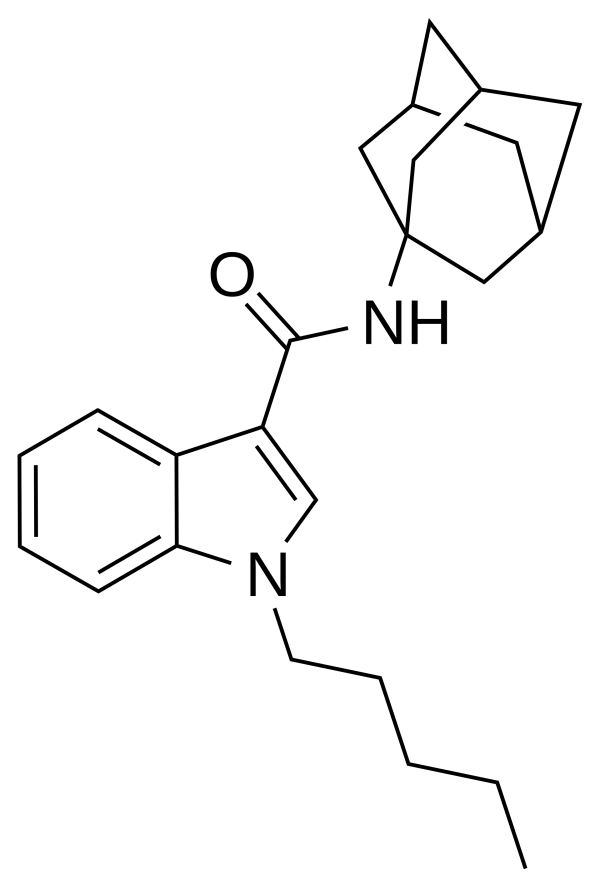
APICA, also known as SDB-001 or 2NE1, is a synthetic cannabinoid in the adamantyl-indole carboxamide family. It is structurally related to JWH-018 adamantyl derivatives, but contains a carboxamide linker rather than the ketone linkage found in adamantoylindoles. APICA has been identified in herbal smoking mixtures and studied for its activity at cannabinoid receptors, although human clinical data remain limited.
Chemistry and identification
APICA is N-(1-adamantyl)-1-pentyl-1H-indole-3-carboxamide. It contains an indole core, a pentyl chain attached to the indole nitrogen and an adamantyl group connected through a carboxamide. It should not be confused with APINACA, also known as AKB48, which has an indazole core instead of an indole.
APICA was reported in European drug-monitoring systems in 2012 and was detected in powders and herbal smoking mixtures. The compound is also known as SDB-001 in analytical and research literature (EUDA: Synthetic cannabinoids in Europe; Cayman Chemical product information: APICA).
Pharmacology
APICA has been examined in functional assays at CB1 and CB2 receptors. A comparative study of APICA and its terminally fluorinated analogue STS-135 found agonist activity at both receptor subtypes. The same study used rat telemetry to assess cannabimimetic responses, including changes in body temperature and heart rate (Banister and colleagues, 2015).
Research on APICA metabolites found that several phase I metabolites retained activity at CB1 and CB2 receptors when they did not contain a carboxylic acid group. This suggests that some metabolites may contribute to the overall pharmacological profile rather than acting only as inactive elimination products (Metabolite pharmacology of APICA and related cannabinoids, 2017).
Reported effects
There is limited reliable human information describing a characteristic APICA experience. Its receptor activity is consistent with cannabimimetic effects, but controlled human studies and a well-defined clinical case series have not established a predictable subjective profile.
Reports involving other adamantyl-indole cannabinoids include altered perception, sedation, impaired coordination and cardiovascular changes. These observations concern the broader class and do not confirm the effects of APICA itself.
Metabolism and toxicology
APICA undergoes phase I metabolism, and some of its hydroxylated metabolites retain cannabinoid receptor activity in vitro. This is relevant to forensic interpretation because the biological effects of a synthetic cannabinoid may not be determined solely by the parent compound.
Neither the human toxic range nor the long-term safety of APICA has been well characterised. The available evidence is based mainly on receptor assays, animal models, analytical identification and metabolite research.
Related compounds
APICA is related to APINACA, STS-135, AB-001 and 5F-AKB48. Its indole core distinguishes it from the indazole structure of APINACA, while its carboxamide linker distinguishes it from adamantoylindoles.
Reviews
There are no reviews yet.